Trusting a model
MMM channel with constant spend: why it can't be measured
An MMM channel with constant spend gives a model nothing to compare. Learn the 15% coefficient-of-variation check, why more weeks fail, and four remedies.
Brandon Cade · Sep 29, 2026 · 7 min read
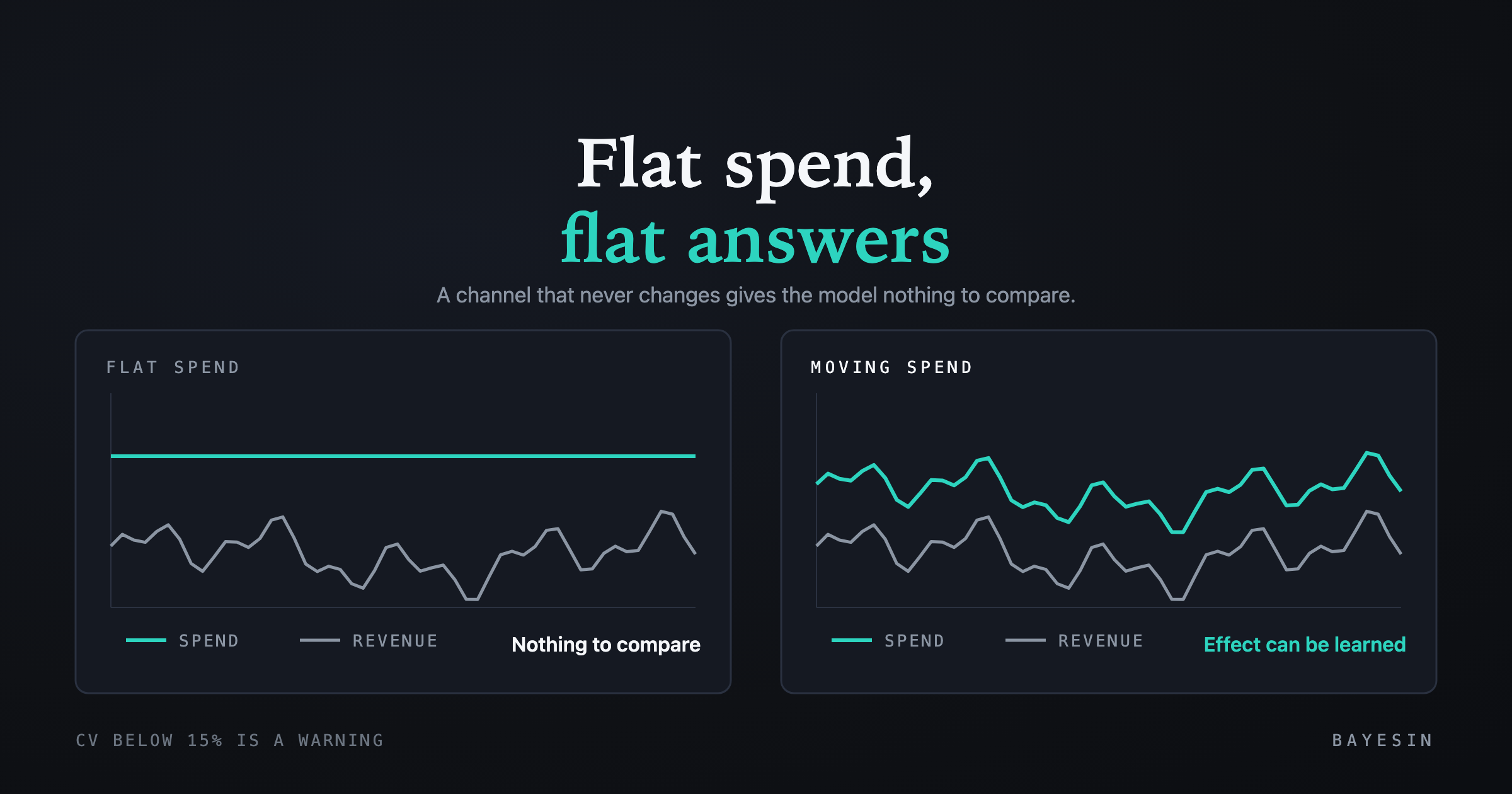
Key Takeaways
- A mix model learns a channel's effect by comparing weeks of higher and lower spend, so a channel with constant spend offers no comparison.
- This is a limit of the data rather than a flaw in the model, and adding weeks alone does not remove it.
- You can measure spread with the coefficient of variation, which is the standard deviation divided by the mean. Bayesin warns below 15%.
- Four remedies exist: add variation deliberately, combine the channel with a similar one, set it aside as baseline, or measure it with a holdout or lift test.
An MMM channel with constant spend is often a sensible business decision, as with steady brand investment, continuous search coverage or a fixed retainer. It nevertheless creates a measurement problem, and the problem is the same for every mix model. This guide shows how to recognize the problem, test for it in your weekly data, and add the contrast a model needs. For the wider set of checks, see the guide to validating a marketing mix model.
Why an MMM channel with constant spend cannot be measured
A mix model estimates a channel's effect by comparing outcomes in weeks with more spend against weeks with less. When spend is identical every week, no comparison exists, and any change in revenue could belong to the channel, the baseline or something else entirely.
Meta's Robyn guide gives the standard example, which is also the constant-spend case stated directly. It says variation is essential: if sales vary weekly while TV activity stays constant, the model can have difficulty determining TV's effect. Think of a thermostat that has never been touched. You cannot learn how much it heats the room, because you never observed the room without it.
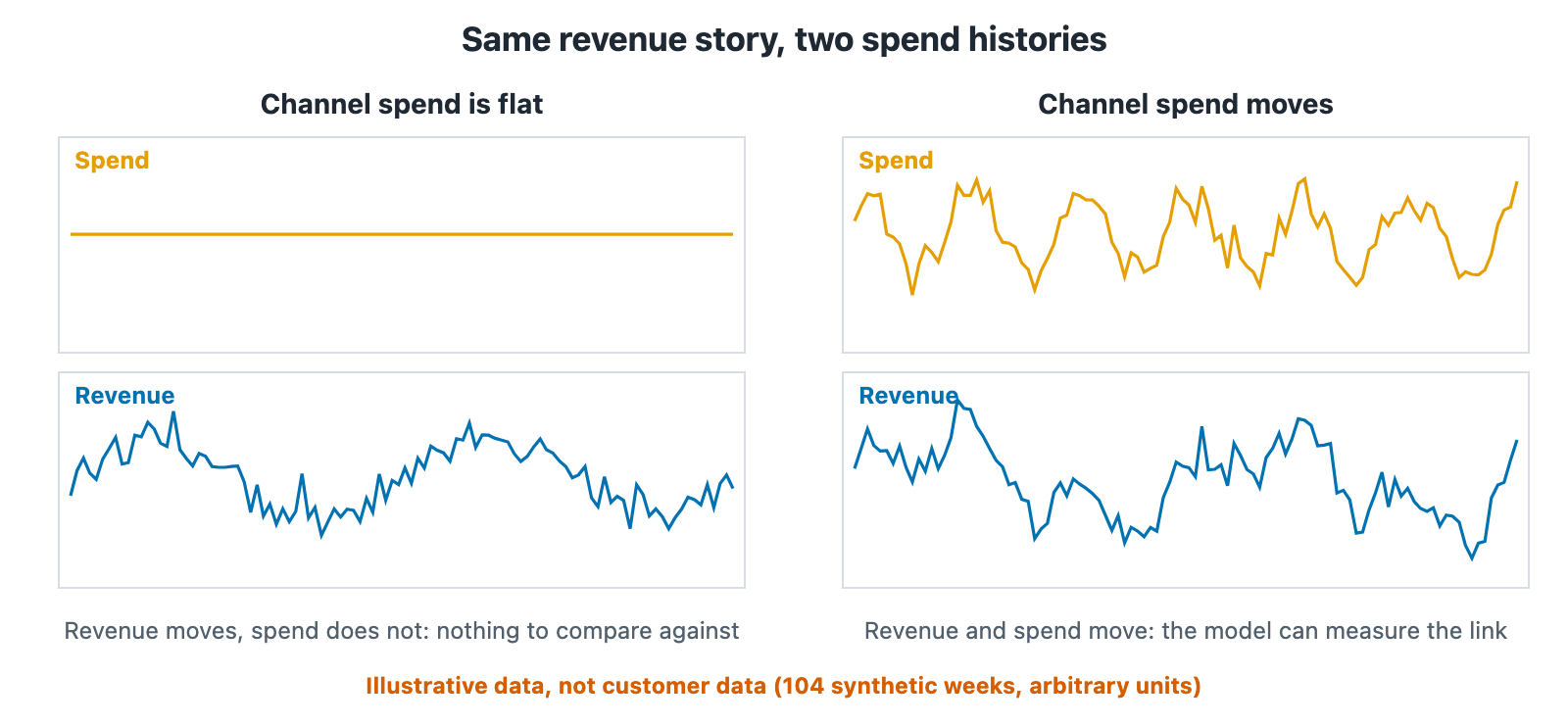
Figure 1. The same revenue pattern with two spend histories. On the left, spend is constant, so nothing links it to revenue.
What each source says about flat and low-spend channels
Two problems are easy to confuse, and the sources cover them differently. Constant spend describes a channel that barely varies from week to week, whereas low spend describes a channel that is small in absolute terms. Only the first is the subject of this post, so I state plainly which source addresses which.
- Robyn, analyst's guide — What it covers: Sales vary while TV stays constant; the model struggles to isolate TV; Constant spend?: Yes, directly
- Meridian, "Amount of data needed" — What it covers: Insufficient variation in media spend adversely affects national models; Constant spend?: Yes, directly
- Meridian, "Model debugging" — What it covers: Asks whether variation in a media or control variable is too small to estimate; Constant spend?: Yes, directly
- Meridian, "Run model diagnostics" — What it covers: With little information, prior and posterior are similar, particularly for low-spend channels; suggests dropping or combining them; Constant spend?: Low spend; same mechanism
- Meridian, "Calibrate treatment priors" — What it covers: Without a strong prior, a low-spend channel may appear to drive massive revenue; Constant spend?: Low spend; same mechanism
The last two rows concern channels with low spend, which is a different condition. I include them because the mechanism is shared, since whenever the data carries little information about a channel, the posterior stays close to the prior. The Meridian pages do not claim that constant spend is the cause.
What a model does with a flat channel
With no contrast, a model must place the channel's effect somewhere, and it falls back on its starting assumptions. The usual outcomes are a wide interval, a result that echoes the prior, or an effect absorbed into the baseline. All three look different from a clean measurement.
The debugging page of Meridian supplies a check worth running. It asks whether variation in a media or control variable is too small to estimate its effect. Its data-volume page adds that insufficient variation in media spend adversely impacts national models. The requirement is therefore explicit in Google's guidance as well as in Meta's.
Checking your own channels for flat spend
Use the coefficient of variation, or CV, which is the standard deviation of weekly spend divided by its mean. It expresses spread as a share of the average, so a CV near zero means the channel barely moves. The steps below take about ten minutes per channel.
- Export weekly spend for the channel across your full history, one row per week.
- Compute the mean and standard deviation of the weeks with spend.
- Divide the standard deviation by the mean. The result is the CV.
- Compare it with a bar. The platform warns below 0.15, meaning spend moves less than 15% of its own average.
- Plot the weekly line. A chart reveals what one number can hide, such as a single large step that makes a channel look variable.
The following example uses illustrative synthetic numbers, not customer data.
- Channel A (steady) — Eight weekly spends: 9,800; 10,200; 10,000; 9,900; 10,100; 10,300; 9,700; 10,000; Mean: 10,000; CV: about 0.02
- Channel B (varied) — Eight weekly spends: 4,000; 9,000; 16,000; 6,000; 12,000; 8,000; 14,000; 11,000; Mean: 10,000; CV: about 0.38
Both channels average the same spend, yet only Channel A would be flagged. The average says nothing about whether a channel can be measured, whereas the spread does.
How Bayesin handles a flat channel
The platform warns and still fits the model, because a flat channel is a finding about that channel alone. The message says that a constant channel cannot be separated from the baseline. It suggests varying spend or running a holdout test to measure the channel directly.
Two details matter for accuracy. The CV uses each channel's weekly totals rather than raw rows, so splitting a constant channel across revenue lines does not disguise it. A channel with spend in fewer than 26 weeks counts as sparse instead of flat. It receives a separate warning and a suggestion to group it with a similar channel.
Flat spend also surfaces in the baseline check. The caveat wording for a very low baseline share names the usual cause, which is spend that never drops near zero anywhere in the history. I trace that link in what a baseline share too high or too low means.
More weeks will not fix a flat channel
A longer history of constant spend is still constant spend, because weeks add observations but no contrast for that channel. Sample size and variation are therefore separate requirements, and a model needs both.
Weeks still matter for everything else, because a short history widens every interval, and the weeks-of-data post covers those thresholds. Meridian's data-volume page treats the two concerns separately as well, listing sample size and spend variation as distinct influences on a national model.
Four ways to handle a flat channel
Four practical options exist, and they can be combined. None requires abandoning always-on spend as a policy. The right choice depends on how much the channel matters, how easy a change would be, and how much certainty the budget decision needs.
- Add variation — What you do: Pause or scale the channel in planned steps, ideally not alongside other channels; Trade-off: Costs some short-term performance; gives the next fit contrast
- Combine — What you do: Merge with a similar channel so the group varies; Trade-off: Loses channel-level detail
- Set aside — What you do: Leave it in the baseline and state that its effect is unmeasured; Trade-off: No number for that channel
- Measure directly — What you do: Run a holdout or lift test; Trade-off: Needs a test design and time
Meridian's diagnostics page suggests dropping or combining low-spend channels. Combining is a natural extension for a flat channel, though that page does not address constant spend itself. For the direct route, Robyn's guide strongly recommends calibrating a mix model with experimental results treated as ground truth. Vaver and Koehler at Google described geo experiments in 2011, assigning non-overlapping regions at random to control or treatment.
Meridian's calibration page also cautions that no single formula turns an experiment result into a prior. Experiments and mix models can measure ROI differently, so timing, duration and geography may not line up exactly. Plan the test with the model in mind.
Short answers on flat channels
Is a flat channel the same as an ineffective channel?
No. A flat channel is one the data cannot judge. It may be highly effective or nearly useless, and a mix model cannot tell which. The accurate statement is "not measurable from this history," not "no effect," and only added contrast or a direct test can settle the question.
How much variation is enough?
No universal cutoff exists. The platform warns below a CV of 0.15, which is a working bar rather than a proof of measurability. Meridian's data-volume guidance suggests judging by the width of the credible interval after fitting. An interval wider than you can act on signals that more contrast is needed.
Can I change spend for only a few weeks?
Yes, and it can help considerably. A short, deliberate pause or step gives the model weeks to compare against. Keep other channels steady during the test where you can, so that the change is not confused with theirs. A geo-based holdout is another option.
What if the channel must stay on?
Then measure it another way. Combine it with a related channel, treat it as baseline with a clear note, or run a small regional holdout. Reporting a channel as unmeasured is preferable to reporting a number the data cannot support.
Sources
- Robyn (Meta open source), "An Analyst's Guide to MMM"
- Google for Developers, "Run model diagnostics," Meridian documentation
- Google for Developers, "Model debugging," Meridian documentation
- Google for Developers, "Calibrate treatment priors," Meridian documentation
- Google for Developers, "Amount of data needed," Meridian documentation
- Vaver, J. and Koehler, J., "Measuring Ad Effectiveness Using Geo Experiments," Google Research
See it on your own rows.
Bayesin is pre-launch. Join the waitlist and we will reach out as access opens.
Get new posts by email.
New posts only. See privacy for what we keep.