Trusting a model
How much data does marketing mix modeling need?
How much data for marketing mix modeling? Robyn suggests two years of weekly data, and Bayesin blocks a fit under 52 weeks. Every threshold sits in one table.
Brandon Cade · Sep 29, 2026 · 7 min read
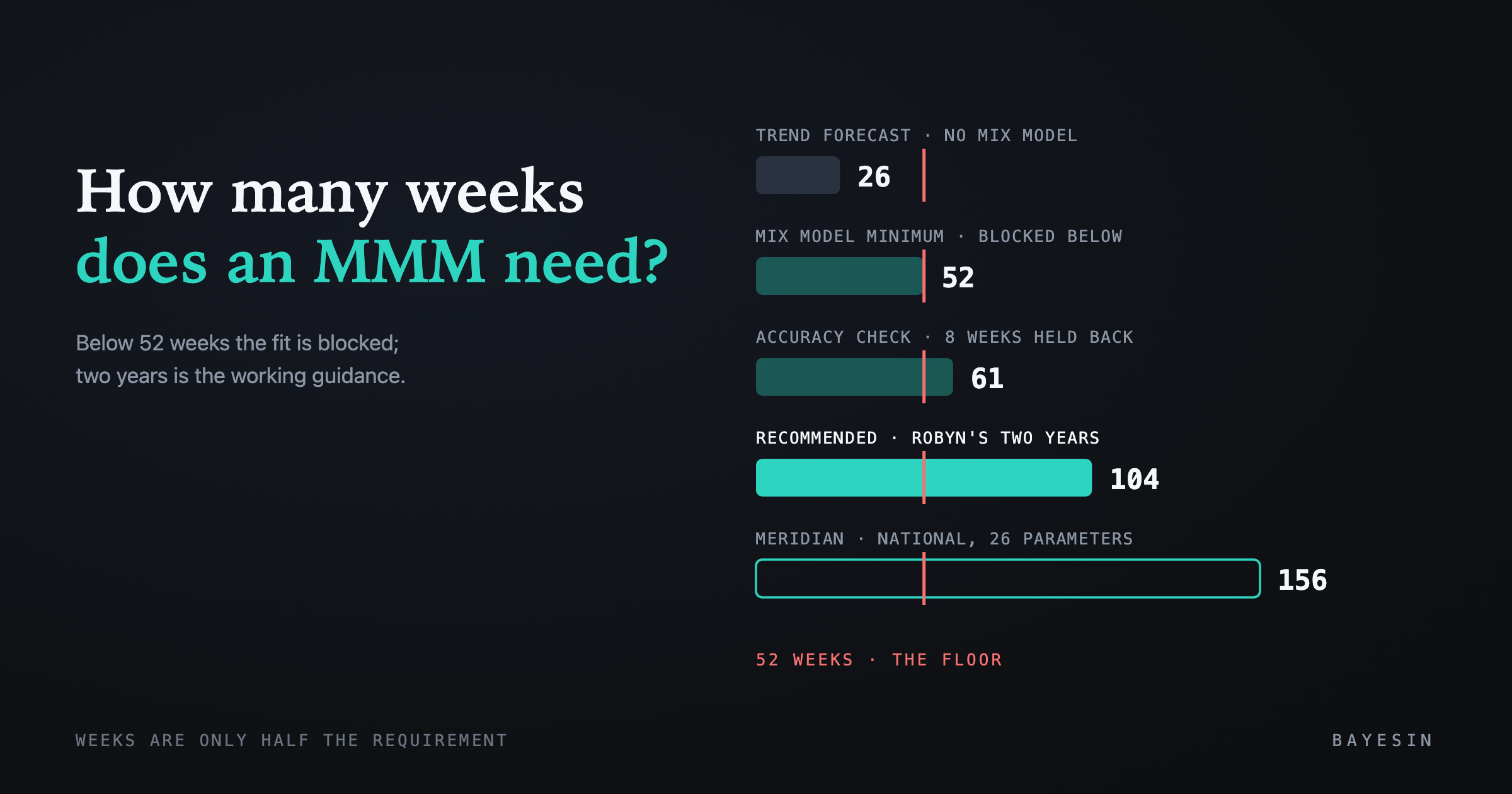
Key Takeaways
- Meta's Robyn guide sets two years of weekly data as a minimum, and Google's Meridian documentation suggests three years for a national model with many channels.
- Bayesin blocks a mix model below 52 weeks and recommends 104.
- Weeks are only half the requirement. A channel whose spend never varies cannot be measured, however long the history.
- A short history often produces a wide interval rather than no answer, and you can still read a wide interval.
The question of how much data for marketing mix modeling has a two-part answer. Below a floor, a model cannot separate media effects from seasonality, and above a comfortable length the intervals become narrow enough to support budget decisions. This post gives the published guidance, the thresholds the platform applies, and the reasoning behind both. The guide to validating a marketing mix model shows where data volume fits among the other checks.
How much data for marketing mix modeling is enough?
Two years of weekly data, about 104 weeks, is the working minimum in public guidance, since one year cannot show a full seasonal cycle twice. Every added channel or control raises the length you need. The platform blocks a fit under 52 weeks and recommends 104, which matches the outside guidance at the upper end.
Meta's Robyn guide states that robust results need at least two years of historical weekly data. Google's Meridian documentation goes further for a national model with many channels, as the next section shows. For scale, the PyMC-Marketing example notebook fits 179 weekly observations.
Why outside guides ask for two or three years
Each estimate a model makes consumes information, and weekly history supplies one observation per week. A model estimating dozens of parameters from 104 observations leaves each one very little to learn from. Meridian's data-volume page works through a concrete example of that limitation.
It counts 26 parameters for a national model with 12 media channels, six controls and eight knots. Two years of weekly data then yields four data points per parameter, which the page calls too low for reliable estimation. Three years (156 weeks) gives about six data points per parameter. The page adds that the most accurate test is to run the model and evaluate the width of the credible intervals.
Weeks and thresholds side by side
Bayesin applies three thresholds to weekly history, plus one for the Forecast view. All four come from named constants in the code, so I can quote them exactly. The table sets them beside the outside guidance, and the figure shows the same numbers as bars.
- 26 — Source: Platform constant; What it means: Floor for a trend forecast, which needs no mix model.
- 52 — Source: Platform constant; What it means: Minimum for a mix model; below it the fit is blocked. Also the point where a yearly seasonal term is fitted.
- 61 — Source: Platform constant; What it means: Needed for the accuracy check: 8 held-back weeks plus 52 for training plus 1.
- 104 — Source: Platform constant, Robyn; What it means: The recommended length and Robyn's stated minimum of two years.
- 156 — Source: Meridian; What it means: Three years, suggested for a national model with 26 parameters.
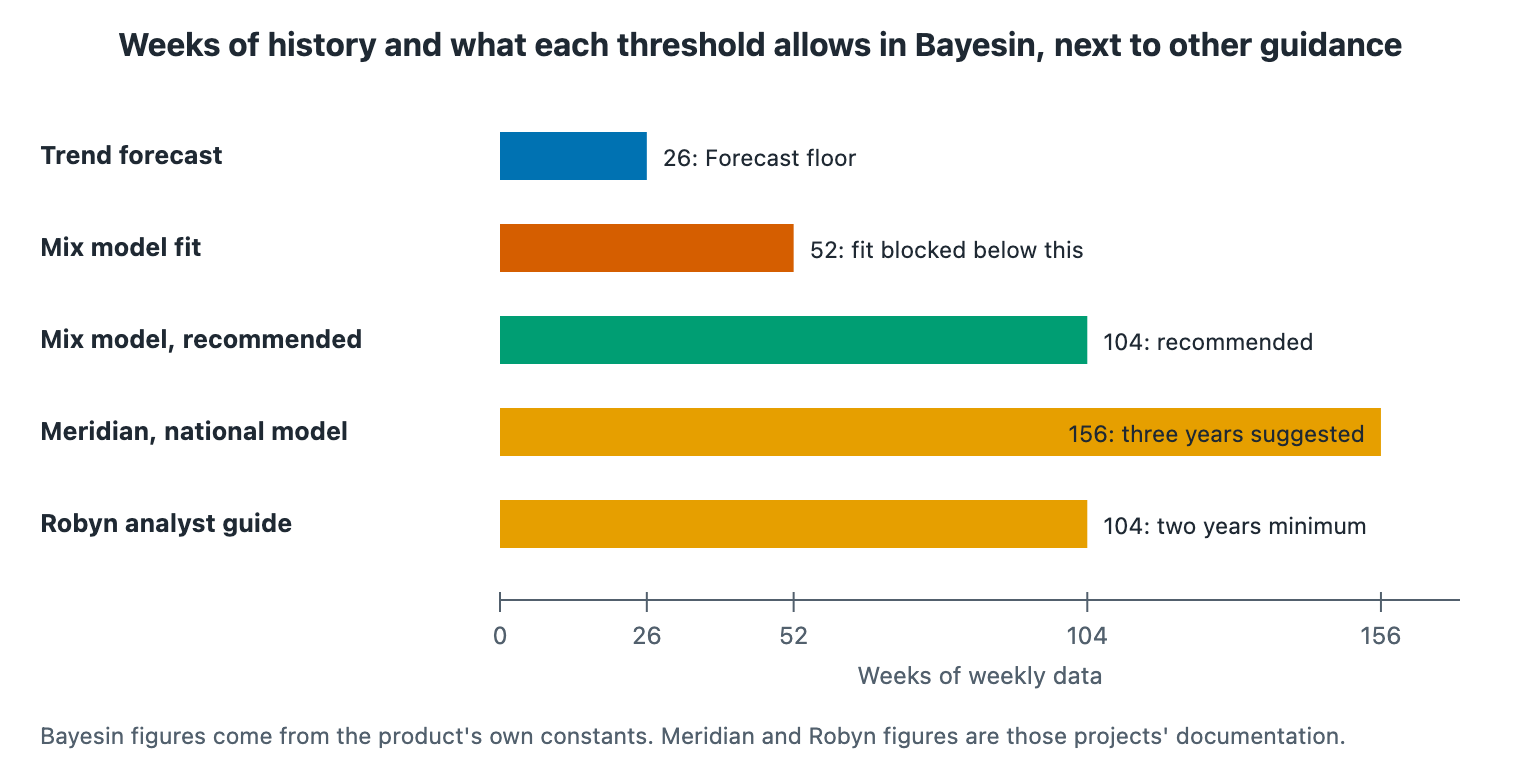
Figure 1. Weeks of history and what each threshold does. The first three bars are the platform's own constants, and the other bars are the guidance of the named projects.
A yearly seasonal shape in the Forecast view also needs 104 weeks. Because these are separate features, the table lists the point at which each one applies.
What happens with fewer than 52 weeks
The mix model does not run, and the message states how many more weeks you need. Other views still work, because the overview, and the Forecast from 26 weeks, are built on observed rows rather than on a fitted mix model.
That design is deliberate, since a model fitted on a few months of data can return figures that look precise while carrying almost no information. I think declining to publish them is the more honest behavior, and why a model should be allowed to refuse lays out that reasoning.
With a short history, a direct test becomes attractive, because a holdout or lift experiment measures a channel without a fitted model. The two methods complement each other, as the constant-spend post explains.
What happens with 52 to 103 weeks
The fit runs, and the platform warns that intervals will be wide and that channel-level numbers are directional. A wide interval is the model reporting how little a single year of weekly data can show, which makes it information rather than failure.
Jin and colleagues at Google reported simulation results for a Bayesian mix model in 2017. Their model performed well on large datasets but was sensitive to the priors on smaller samples, which could introduce bias. When history is short, assumptions carry more weight, so results deserve correspondingly more scrutiny. For a method of reading a wide range, see reading a credible interval in a marketing mix model.
Why yearly seasonality needs a full year of weeks
To estimate a yearly pattern, a model has to observe the year at least once. With less than one complete cycle, the seasonal curve cannot be distinguished from trend. Media spend also tends to trend, so seasonality can be mistaken for media.
The platform therefore fits a yearly seasonal term only when the data covers at least 52 weeks. Below that, the model runs without the term and the run carries a caveat, because anything following the calendar is credited to channels. Two cycles let a model check that a pattern repeats, which is one reason the recommended length is two years.
Weeks needed to test a model on held-back weeks
An accuracy check needs 61 weeks. The platform holds back the latest 8 weeks and trains on the rest. The training portion must reach 52 weeks, so that it is a fit the platform would publish on its own. With 60 weeks or fewer, the check is skipped and the run says so.
The check matters because it quantifies how wrong the model would have been on weeks it had not seen. Without that evidence, the published numbers describe history rather than a demonstrated forecast.
More channels need more weeks
Each added channel adds parameters, and each parameter needs data. Meridian's debugging page notes that a model with many variables needs more data to understand any one of them, so grouping similar channels conserves weeks.
The platform also warns about individual channels with spend in fewer than 26 weeks of the history. A channel active for only a few weeks gives the model little to learn from, so its interval will be wide. The suggested remedy is to group it with a similar channel. Low-spend channels raise a related concern, which I cover in the constant-spend post.
Weeks alone do not decide whether a fit works
Weeks give the model observations, but only variation gives it contrast, so a channel held constant for three years cannot be separated from the baseline. Robyn's guide says the model can struggle to determine TV's effect when TV stayed constant while sales moved.
The platform flags a channel whose weekly spend varies by less than 15% of its own average, measured as the coefficient of variation. It is a warning rather than a block, so the fit still runs with a wide interval on that channel. I cover the reasoning in why a channel with constant spend cannot be measured.
What counts as a week
A week is one distinct weekly date, however many rows share it. The platform counts distinct dates rather than rows, so three revenue lines per week do not look like three times the history.
Weeks must also be unbroken, since a gap in the weekly sequence blocks the fit. The remedy is to include every week, using zero for weeks without spend, and to give every period a revenue figure.
Short answers on data volume
Should weeks with zero spend be included?
Yes. Include every week, using zero where there was no spend, and give each week a revenue figure. A missing week breaks the weekly sequence, which blocks the fit here. Omitting quiet weeks would also remove the low-spend contrast from which a model learns.
Is more history always better?
Not always. Older data can describe a business that no longer exists, with a different product mix or offer. More weeks improve precision, but structural changes reduce relevance. Judge whether the older weeks still resemble your current operations, and consider adding controls for known changes.
What if I have 40 weeks of data?
A mix model would be blocked, and the message would state how many weeks are missing. Use the time to build variation, such as deliberate budget changes in different channels. The next 12 weeks will then carry more information than the last 12 did.
Does a longer history guarantee a good fit?
No. A long history with flat spend, unsettled sampling or an implausible baseline can still produce an unusable fit. Weeks are necessary but insufficient on their own, so read the convergence diagnostics and the guide to baseline share alongside this one.
Sources
- Robyn (Meta open source), "An Analyst's Guide to MMM"
- Google for Developers, "Amount of data needed," Meridian documentation (
- Google for Developers, "Model debugging," Meridian documentation
- Jin, Y. et al., "Bayesian Methods for Media Mix Modeling with Carryover and Shape Effects," Google Research
- PyMC Labs, "Media Mix Model example notebook," PyMC-Marketing documentation
See it on your own rows.
Bayesin is pre-launch. Join the waitlist and we will reach out as access opens.
Get new posts by email.
New posts only. See privacy for what we keep.