Blog
Notes on
measuring media.
How media mix models, attribution, and forecasts actually work, written for the people who have to defend the budget.
Planning and forecasting
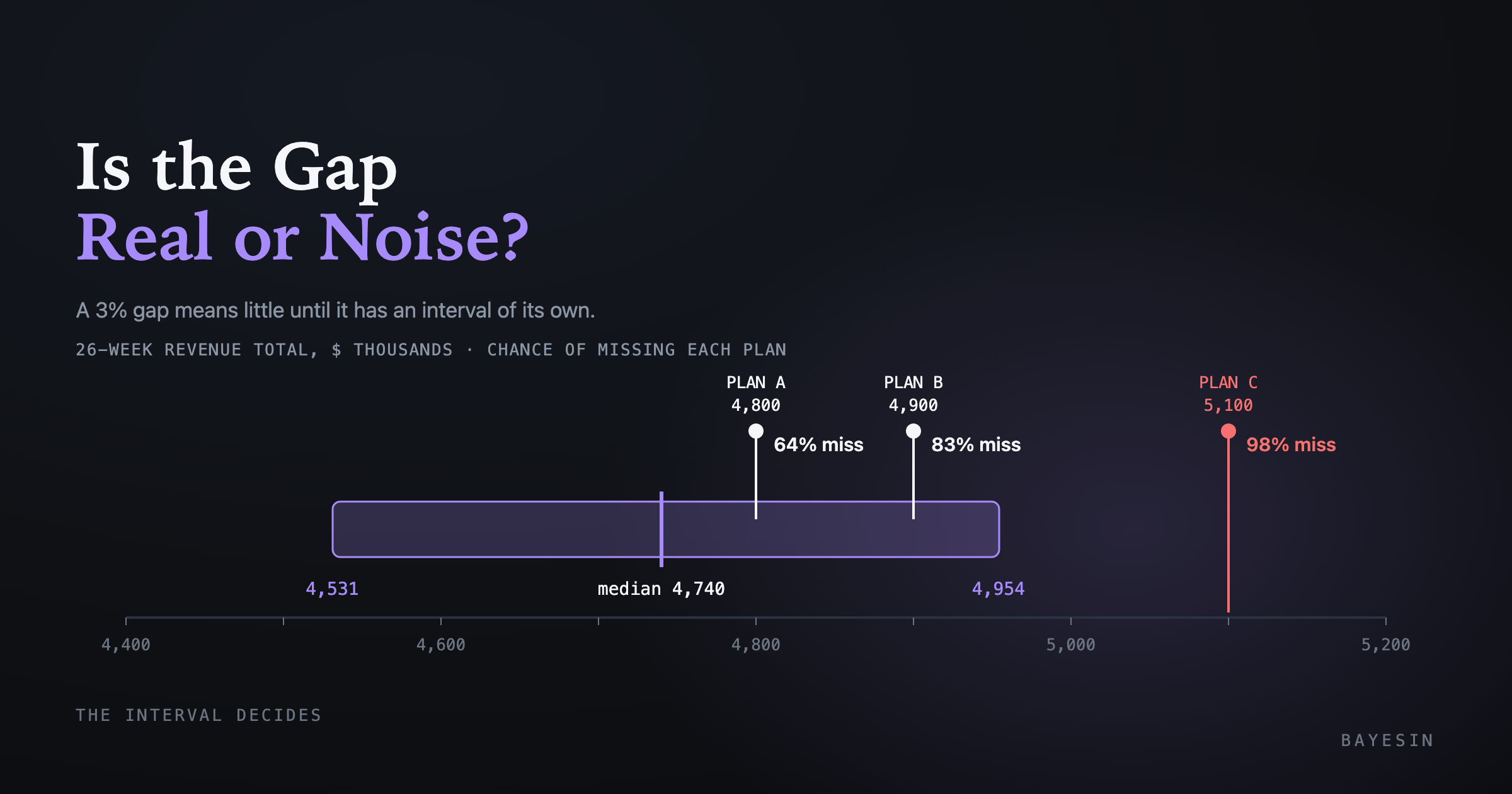
Marketing forecast vs plan variance, with its uncertainty
A forecast that trails plan by 3.3% may or may not be a miss. Learn to compute marketing forecast vs plan variance with an 80% interval and act on what it says.
Oct 15, 2026
Planning and forecasting
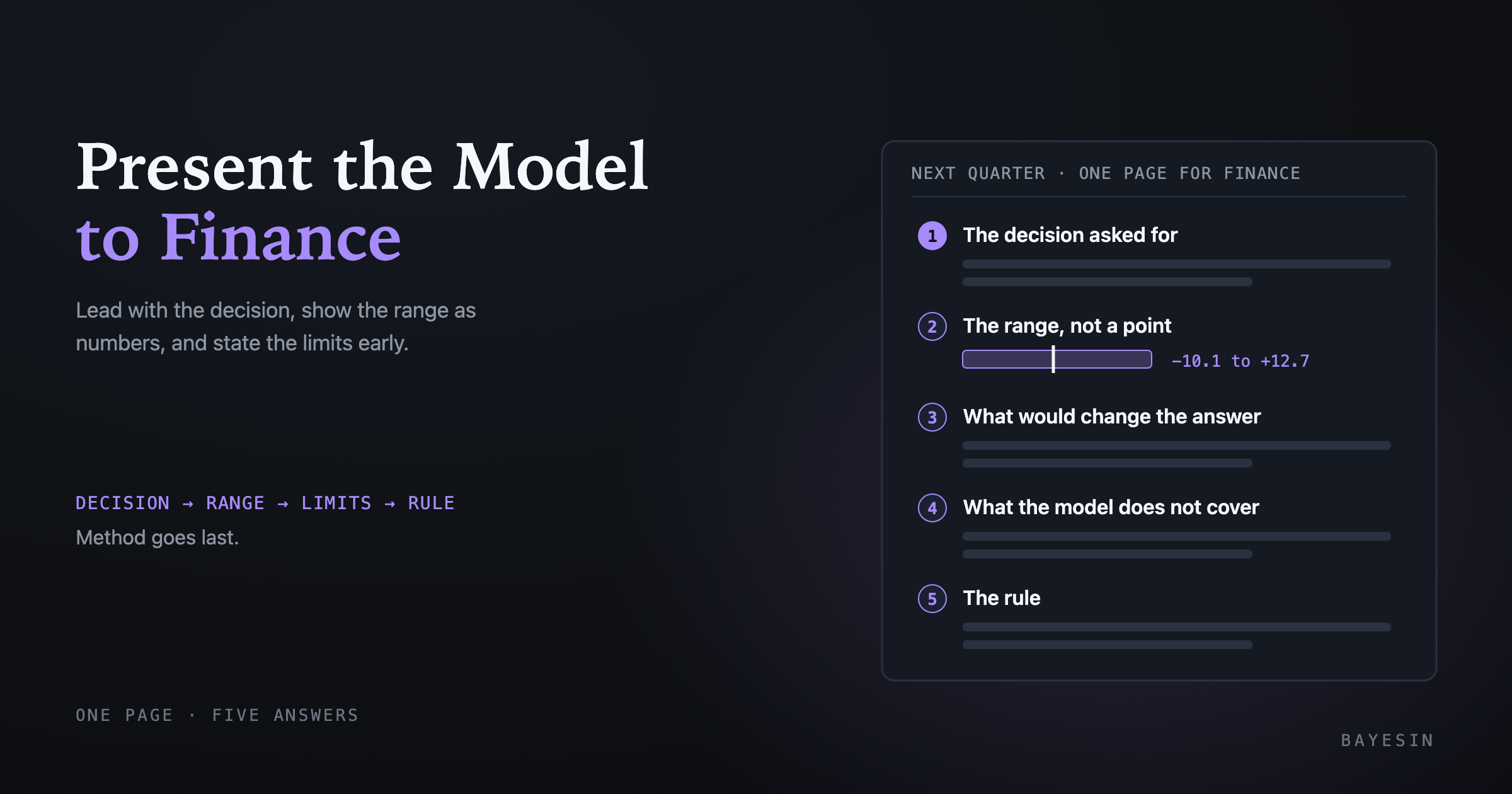
How to present a marketing model to finance
Finance will test a modeled scenario on its range, limits and link to booked revenue. Use a one-page structure and six prepared answers to present it well.
Oct 12, 2026
Planning and forecasting
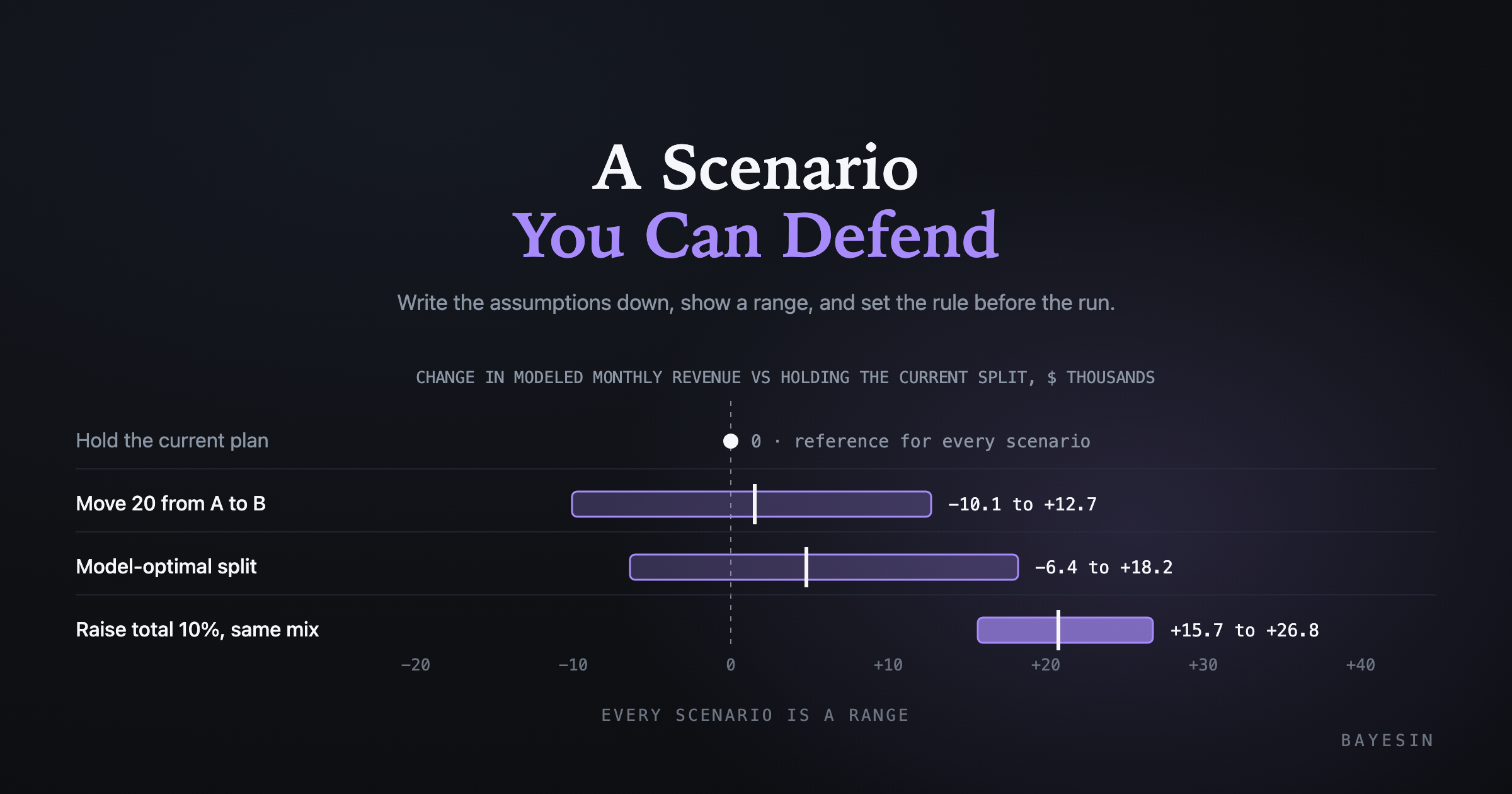
Building a marketing budget scenario you can defend
Marketing budget scenario planning works when each assumption is written down and every result is a range. Follow a four-step method with a filled-in ledger.
Oct 11, 2026

Planning and forecasting
Marketing budget planning with uncertainty, in five steps
A five-step method for marketing budget planning with uncertainty: an 80% interval on the forecast and the gap to plan, then scenarios and a 13-week schedule.
Oct 8, 2026
Planning and forecasting
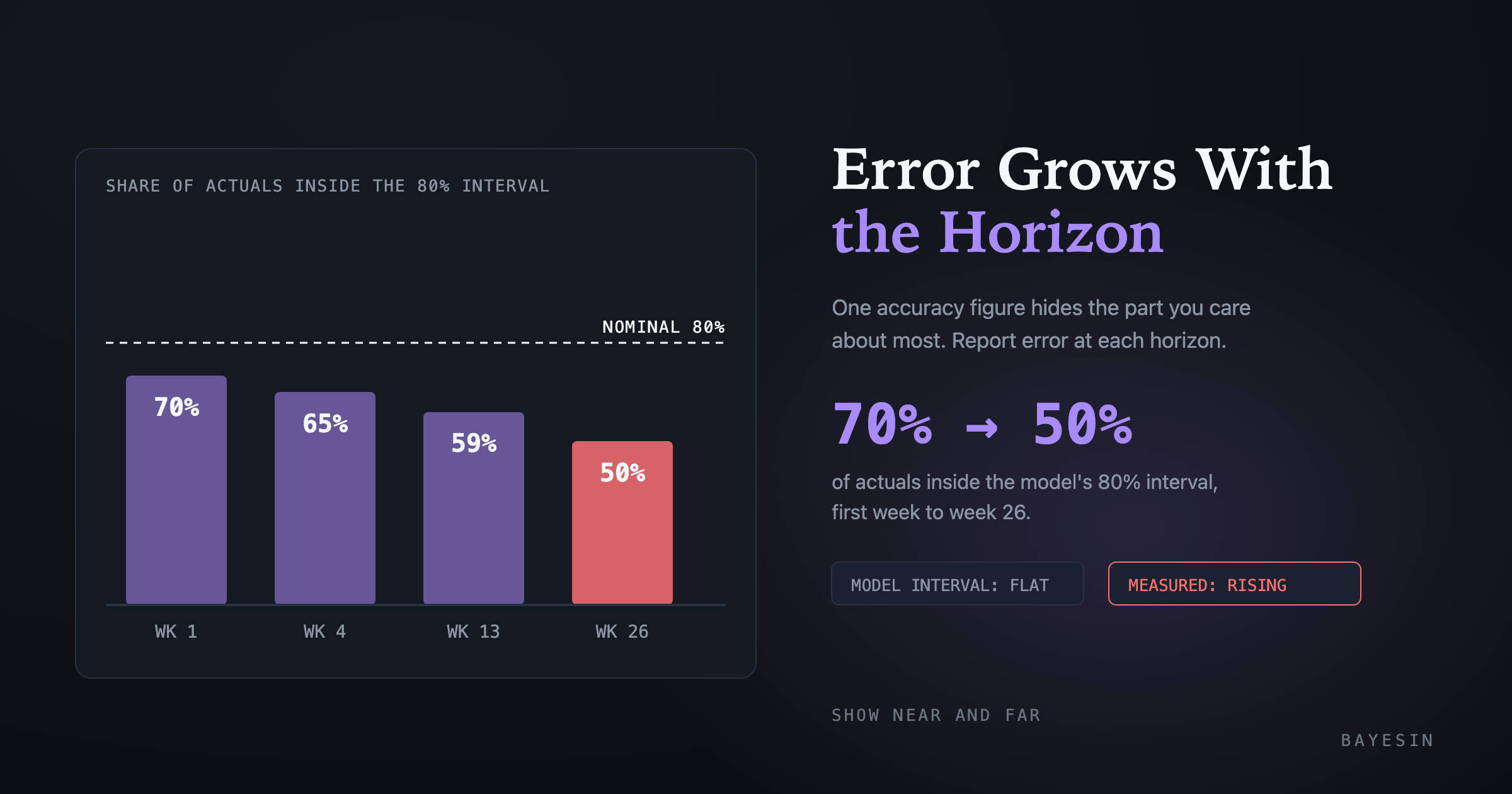
Marketing forecast error by horizon: show near and far
Marketing forecast error grows with the horizon, but a model's own 80% interval may stay flat. Measure error by week with a rolling backtest and report both.
Oct 5, 2026
Planning and forecasting
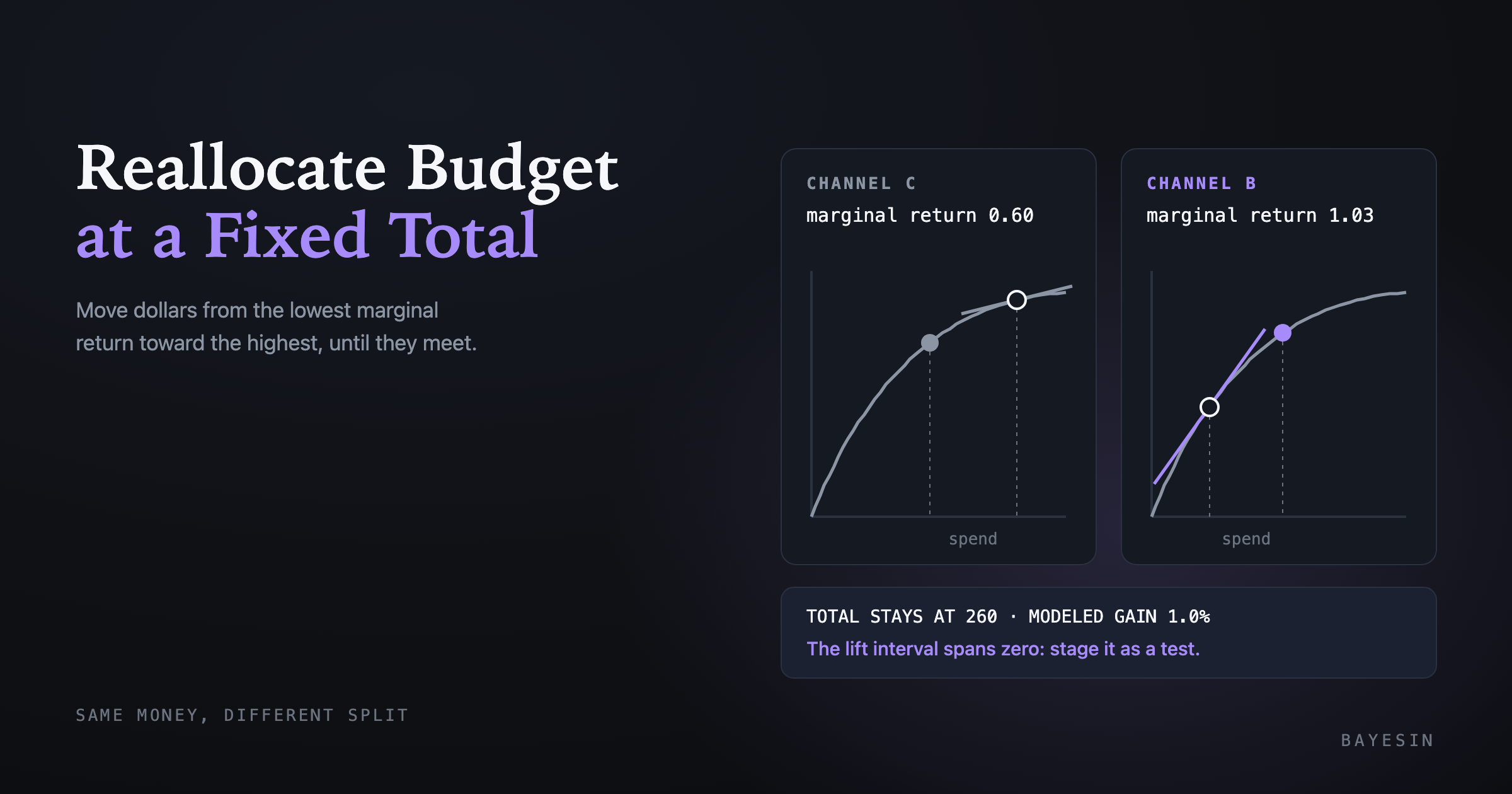
Marketing budget reallocation model at a fixed total spend
Move spend between channels without changing the total. See a marketing budget reallocation model with a worked example and how much a 1% modeled gain deserves.
Oct 4, 2026
Planning and forecasting
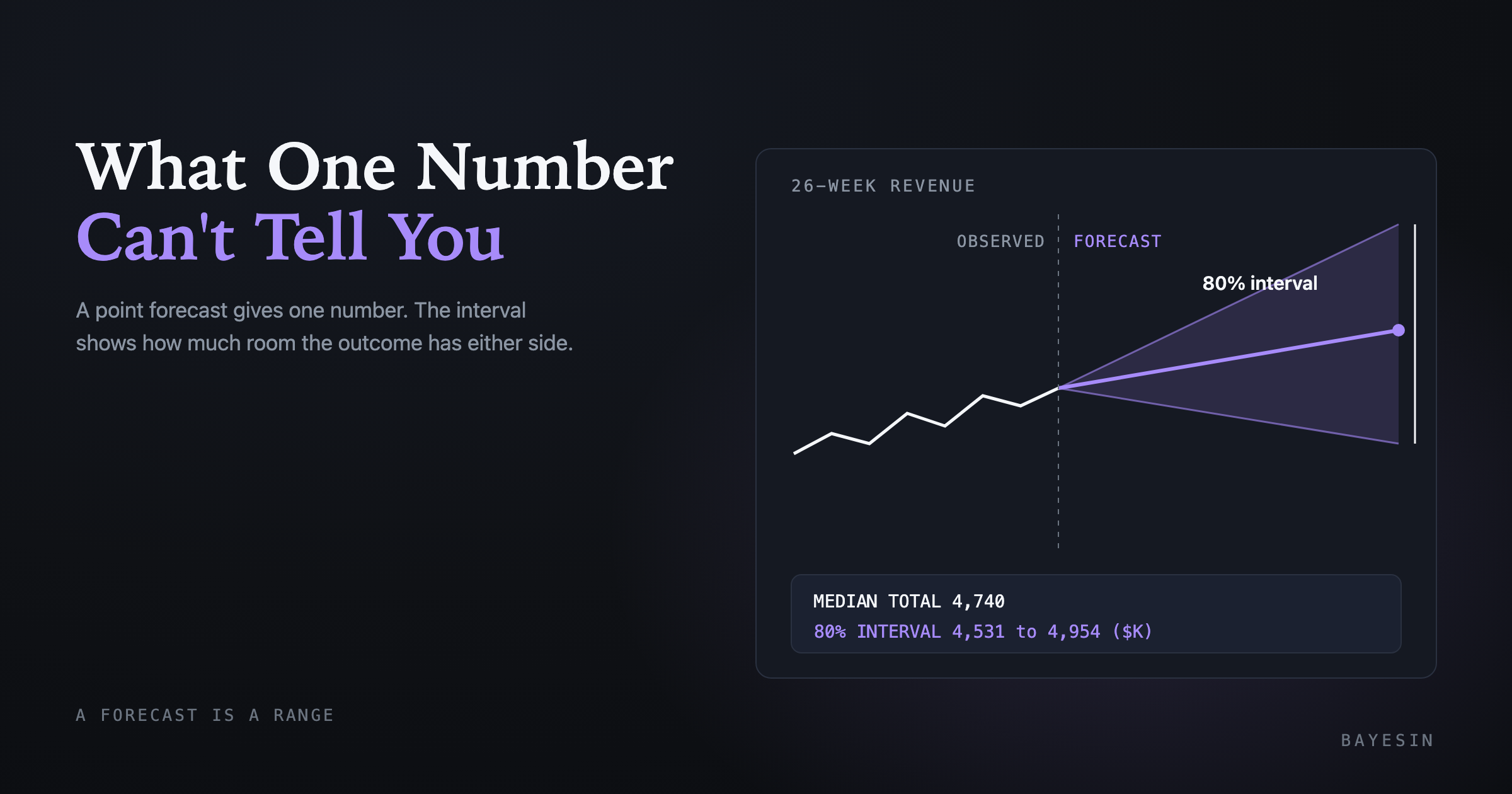
What a forecast interval tells you that one number can't
What does an 80% marketing forecast prediction interval mean? See how wide it should be, what it leaves out, and four questions to ask before you trust it.
Oct 4, 2026
Trusting a model
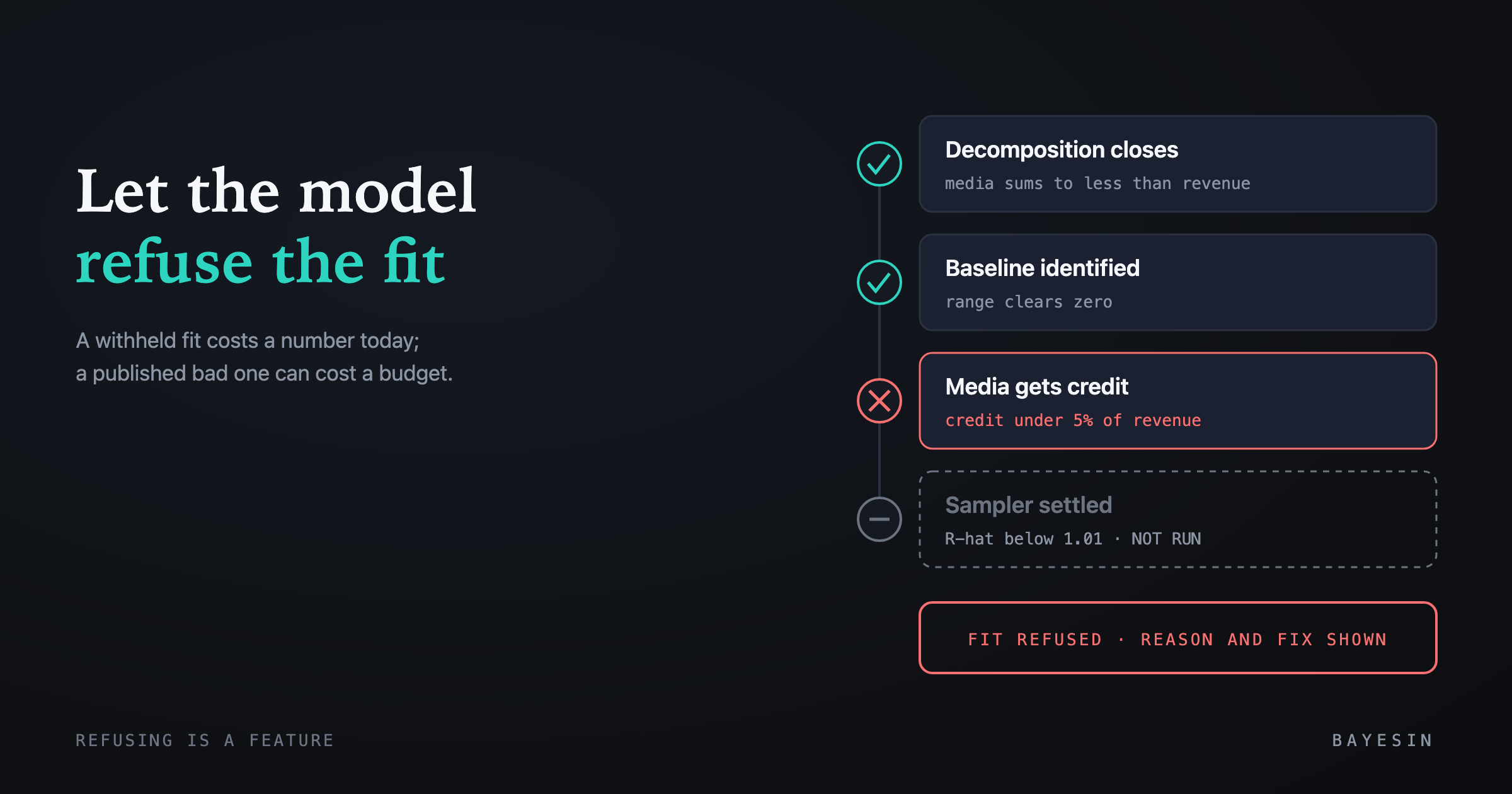
When to distrust marketing mix model results
When to distrust marketing mix model results: four failures where a model should refuse to publish, and four unusual results that deserve a caveat instead.
Oct 1, 2026
Trusting a model
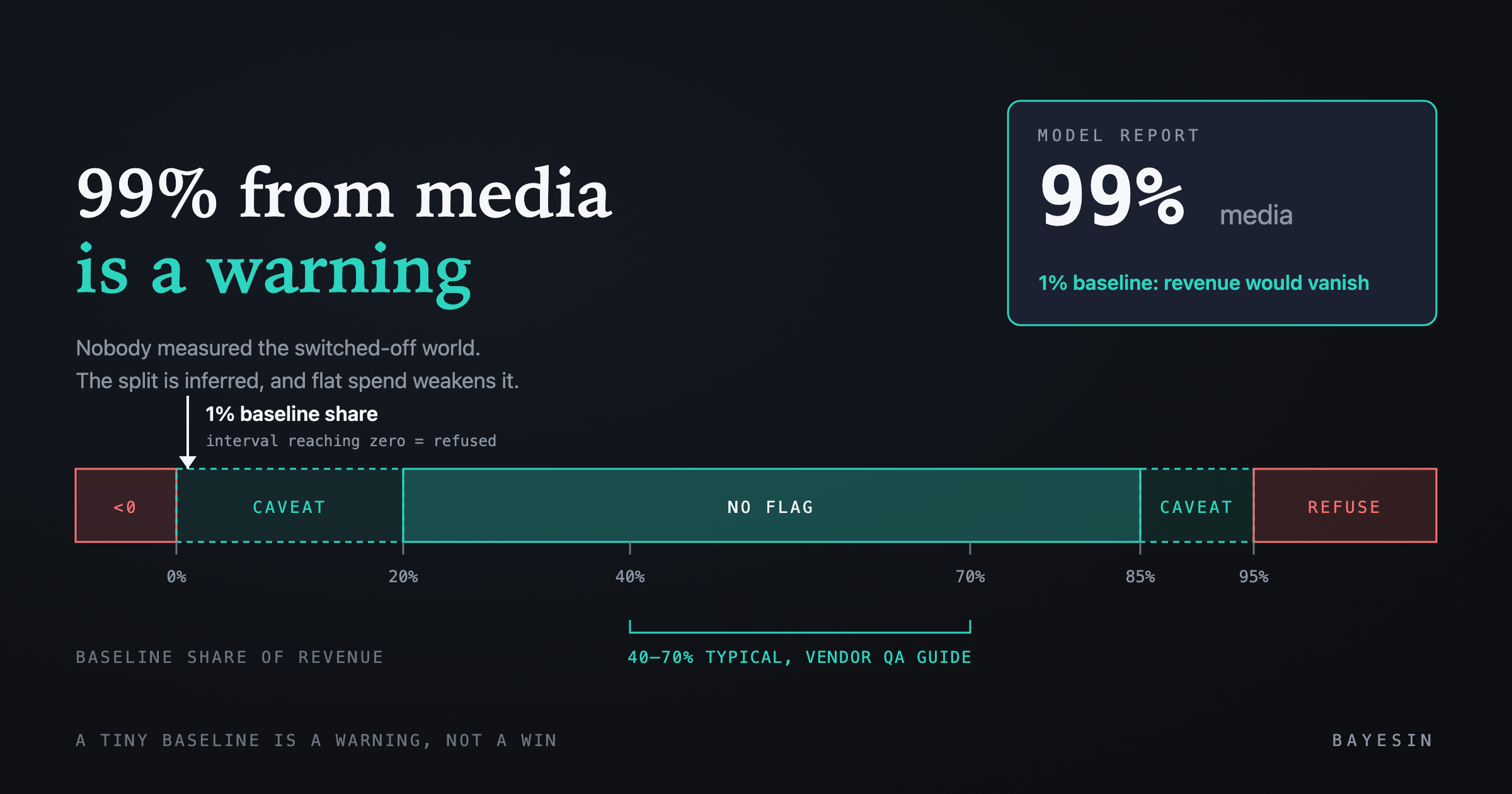
MMM baseline share too high or too low: what it means
Is your MMM baseline share too high or too low? A 99% media share means a 1% baseline. Five checks for a suspicious split, with published ranges of 20% to 85%.
Oct 1, 2026
Trusting a model
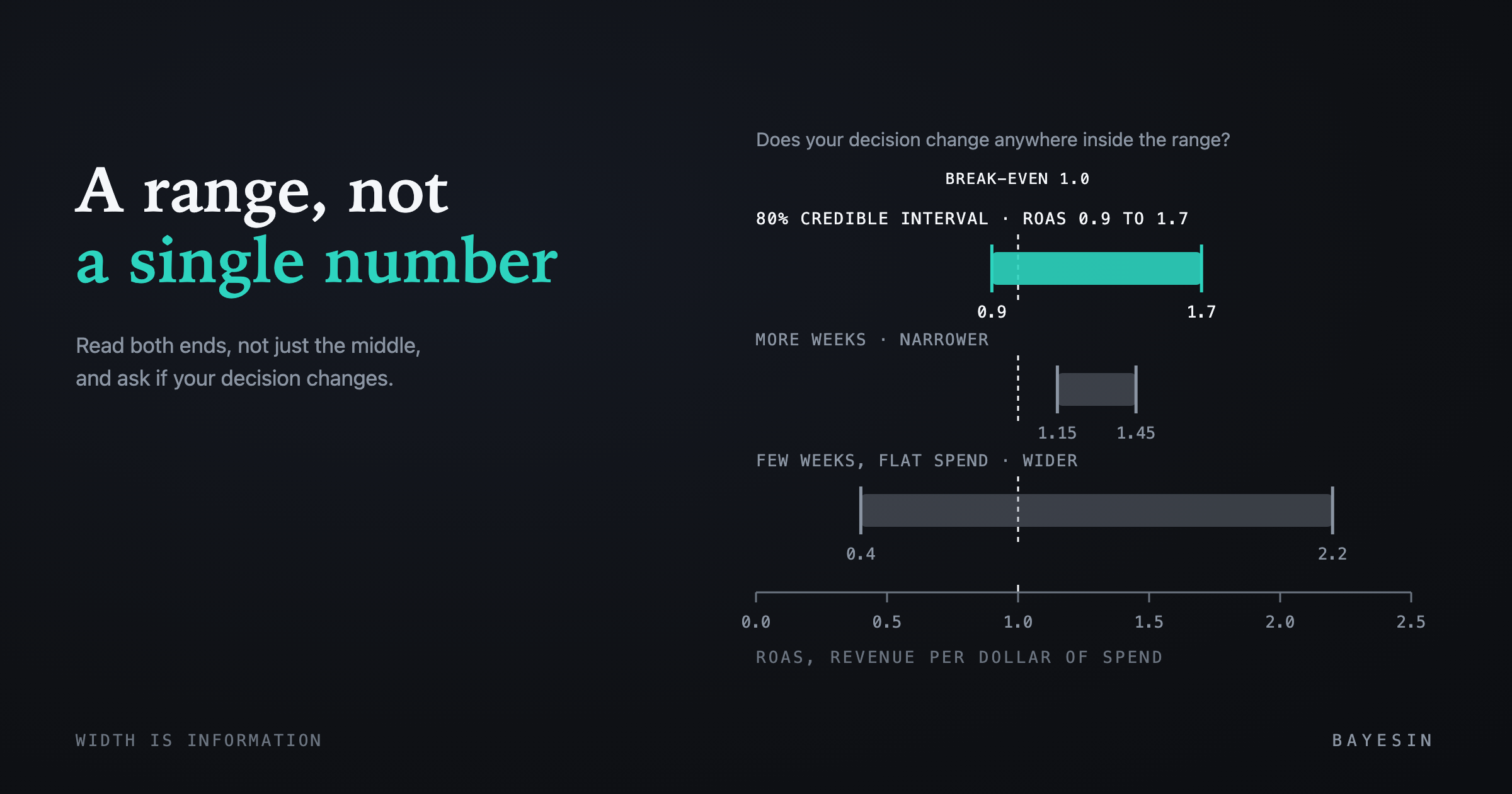
Reading a credible interval in a marketing mix model
How to read a credible interval in a marketing mix model in four steps, with an 80% interval from the 10th to 90th percentile, and what to do when it is wide.
Sep 30, 2026
Trusting a model
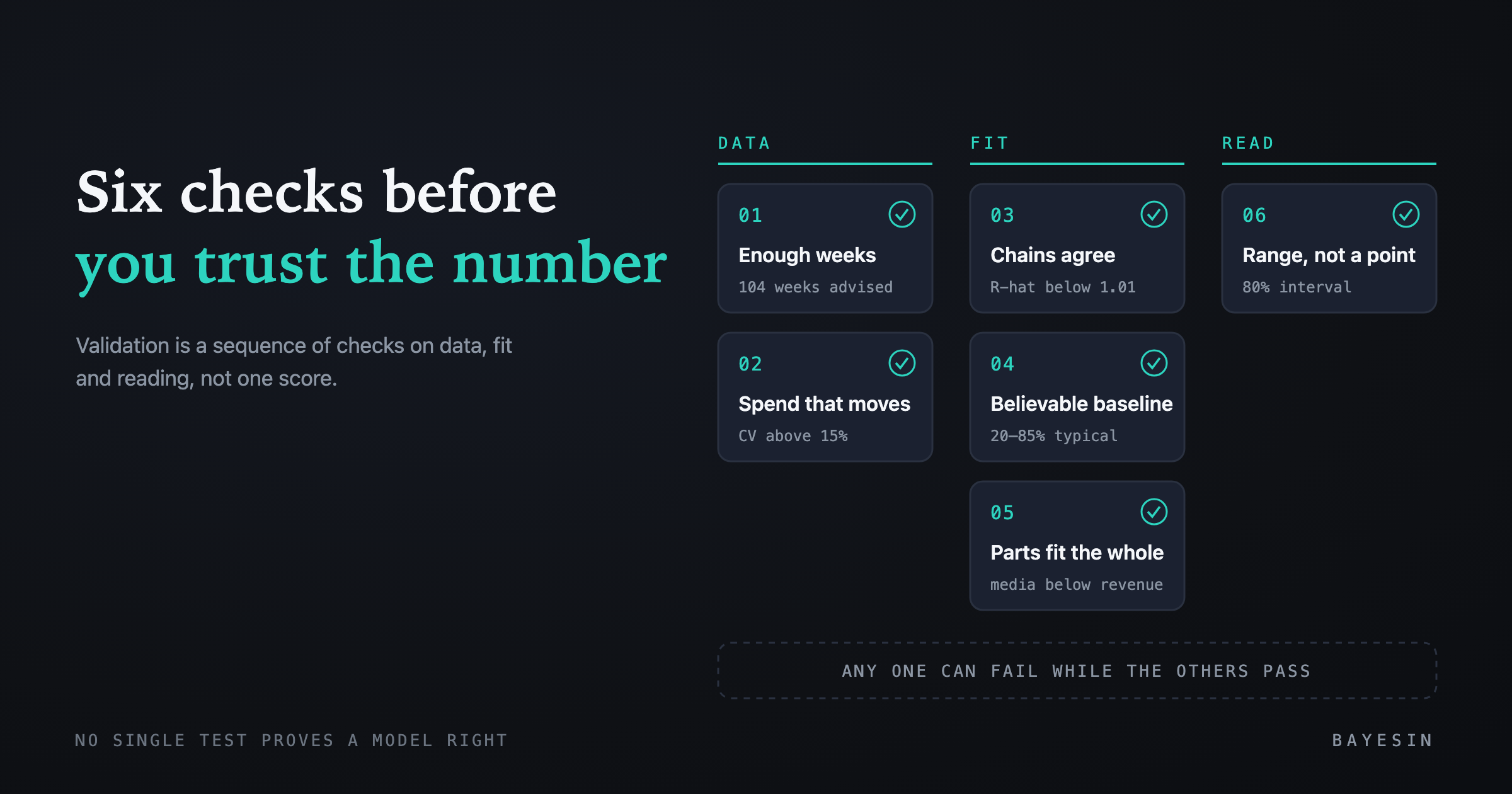
How to validate a marketing mix model: six checks
How to validate a marketing mix model in six checks on data, fit and interpretation, with published thresholds such as R-hat below 1.01 and 104 weeks of data.
Sep 30, 2026
Trusting a model
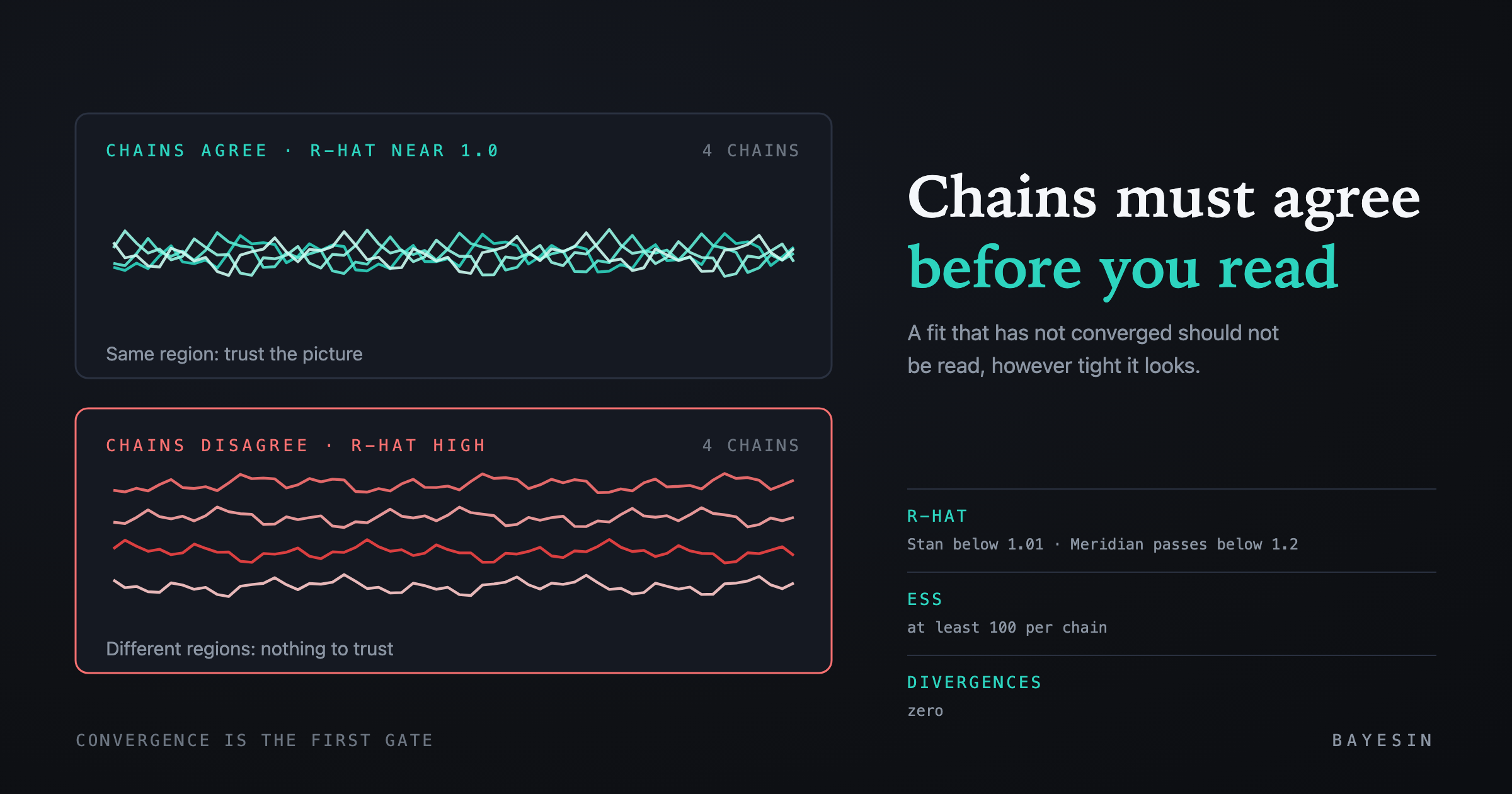
MMM convergence and R-hat for non-statisticians
MMM convergence R-hat explained without jargon: R-hat, effective sample size and divergences, and why Stan asks for below 1.01 while Meridian passes 1.2.
Sep 30, 2026
Trusting a model
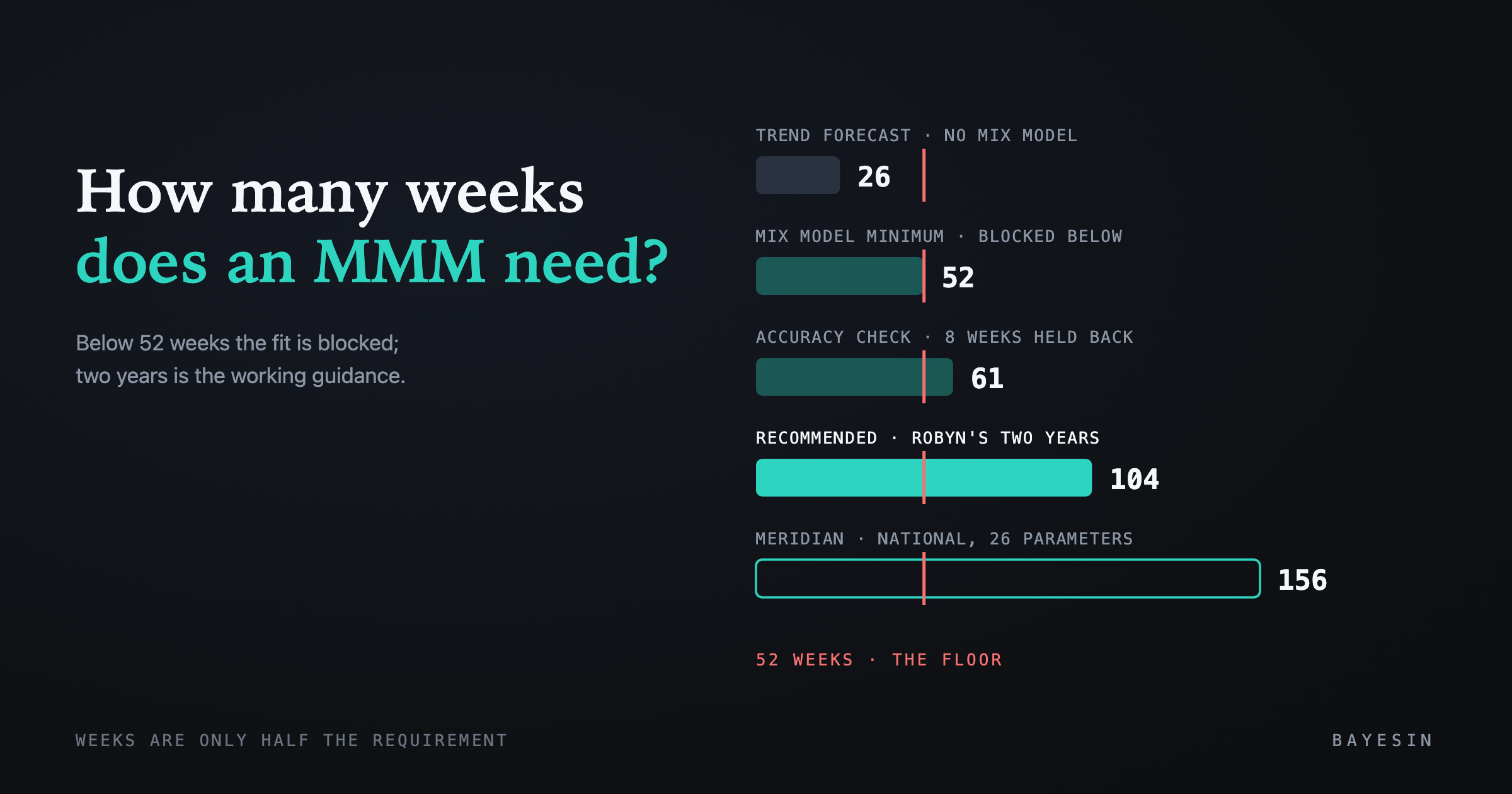
How much data does marketing mix modeling need?
How much data for marketing mix modeling? Robyn suggests two years of weekly data, and Bayesin blocks a fit under 52 weeks. Every threshold sits in one table.
Sep 29, 2026
Trusting a model
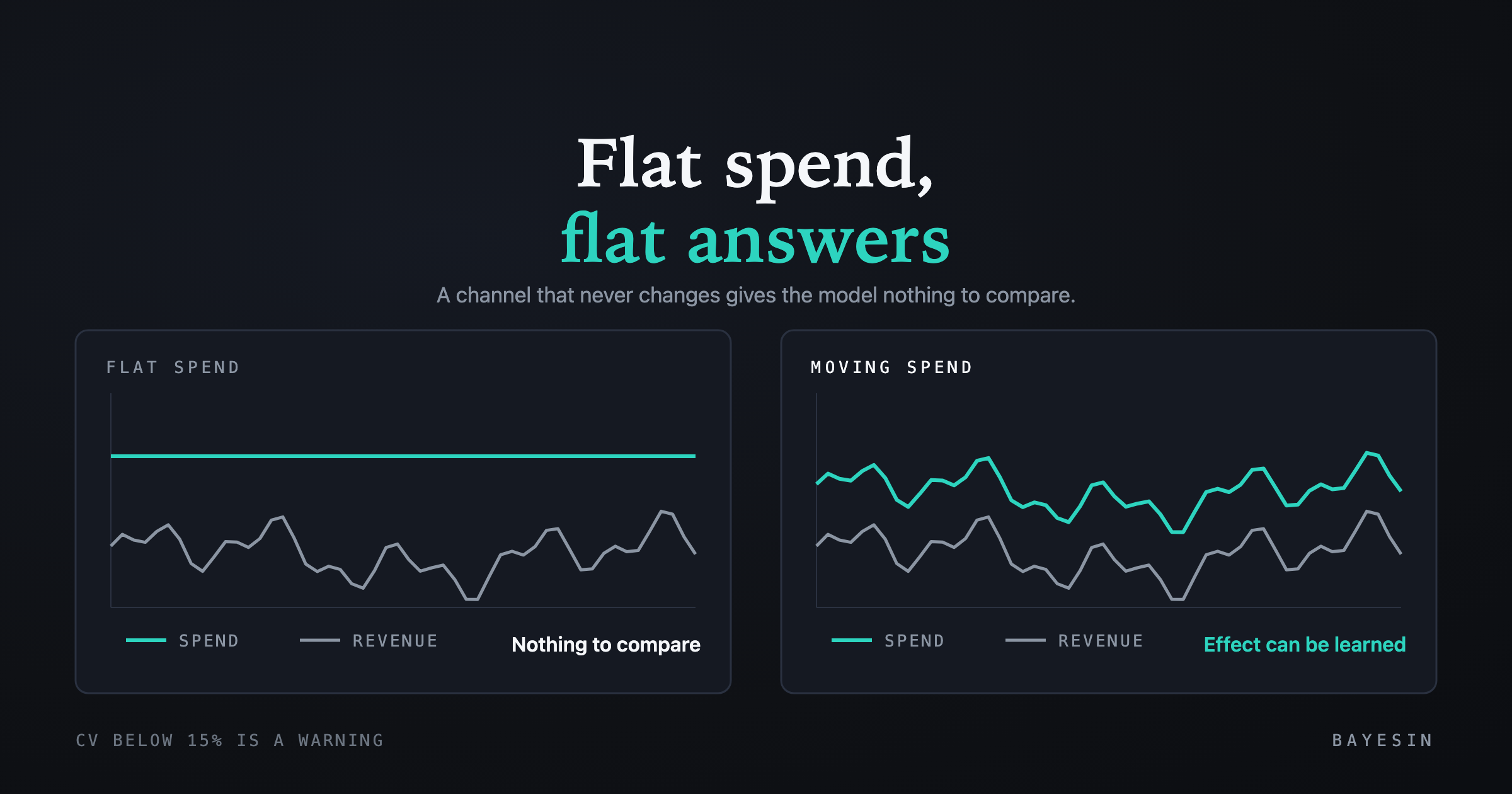
MMM channel with constant spend: why it can't be measured
An MMM channel with constant spend gives a model nothing to compare. Learn the 15% coefficient-of-variation check, why more weeks fail, and four remedies.
Sep 29, 2026
MMM fundamentals
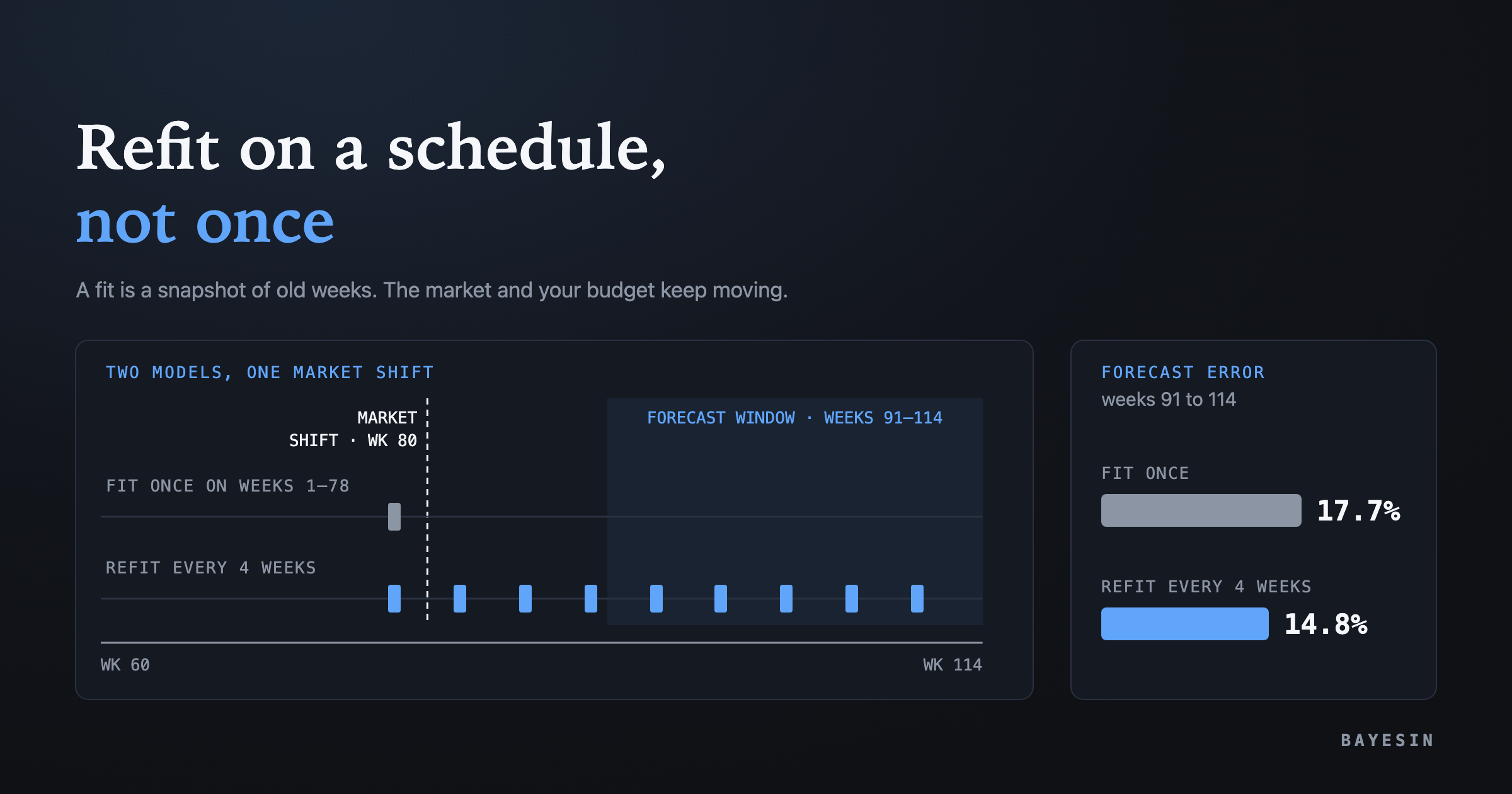
How often to refit a marketing mix model, and why
How often to refit a marketing mix model, and why: in a synthetic backtest, refitting every 4 weeks cut forecast error from 17.7% to 14.8% after a market shift.
Sep 29, 2026
MMM fundamentals
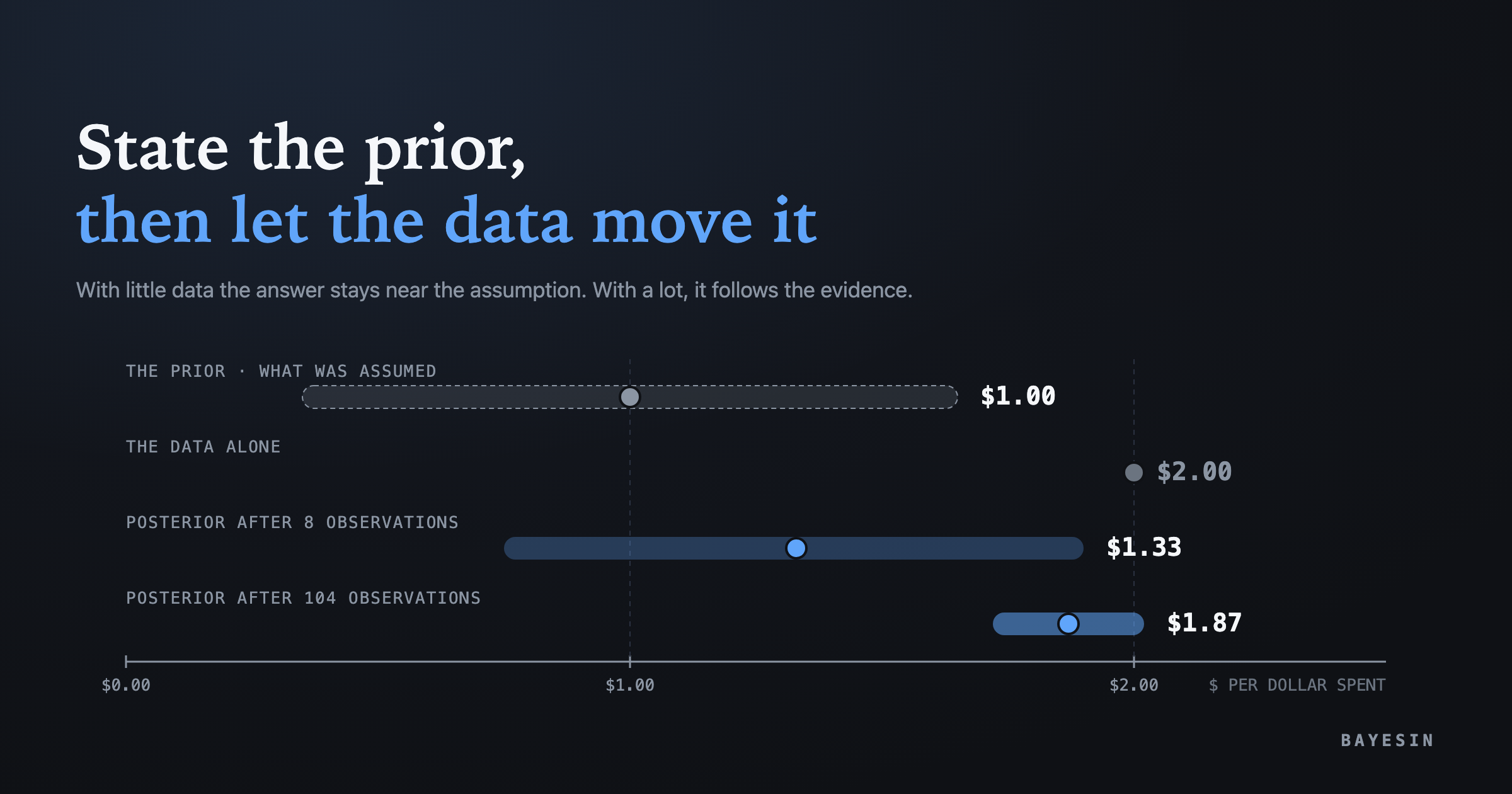
Priors in a Bayesian marketing mix model, explained
Priors in a Bayesian marketing mix model, explained: a $1.00 prior moves to $1.33 with 8 observations and $1.87 with 104, plus how to read and test a prior.
Sep 28, 2026
MMM fundamentals
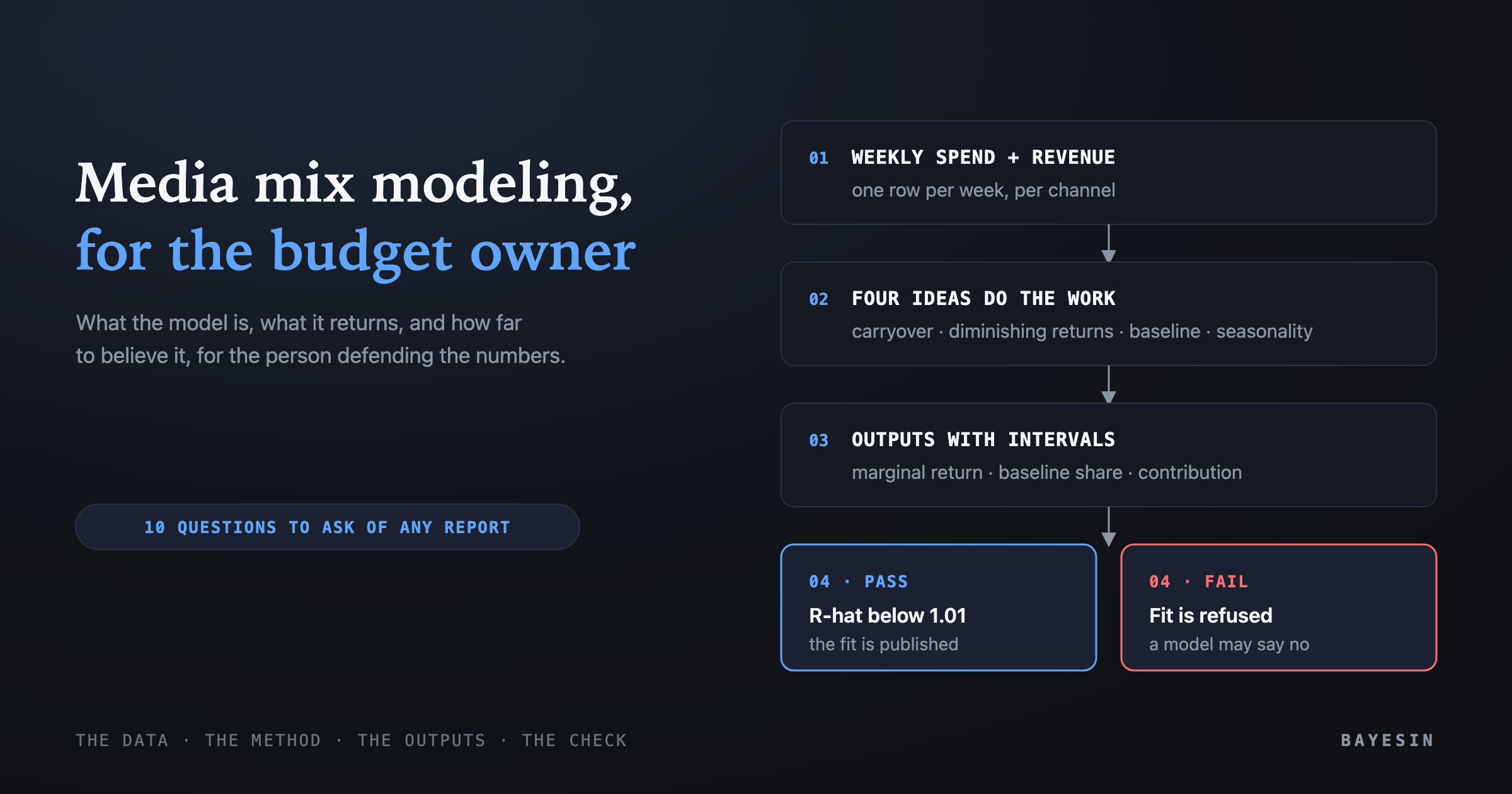
Media mix modeling explained for the budget owner
Media mix modeling explained for the person defending a budget: the data, the method, the outputs, and ten questions plus a 1.01 R-hat check for trust.
Sep 27, 2026
MMM fundamentals
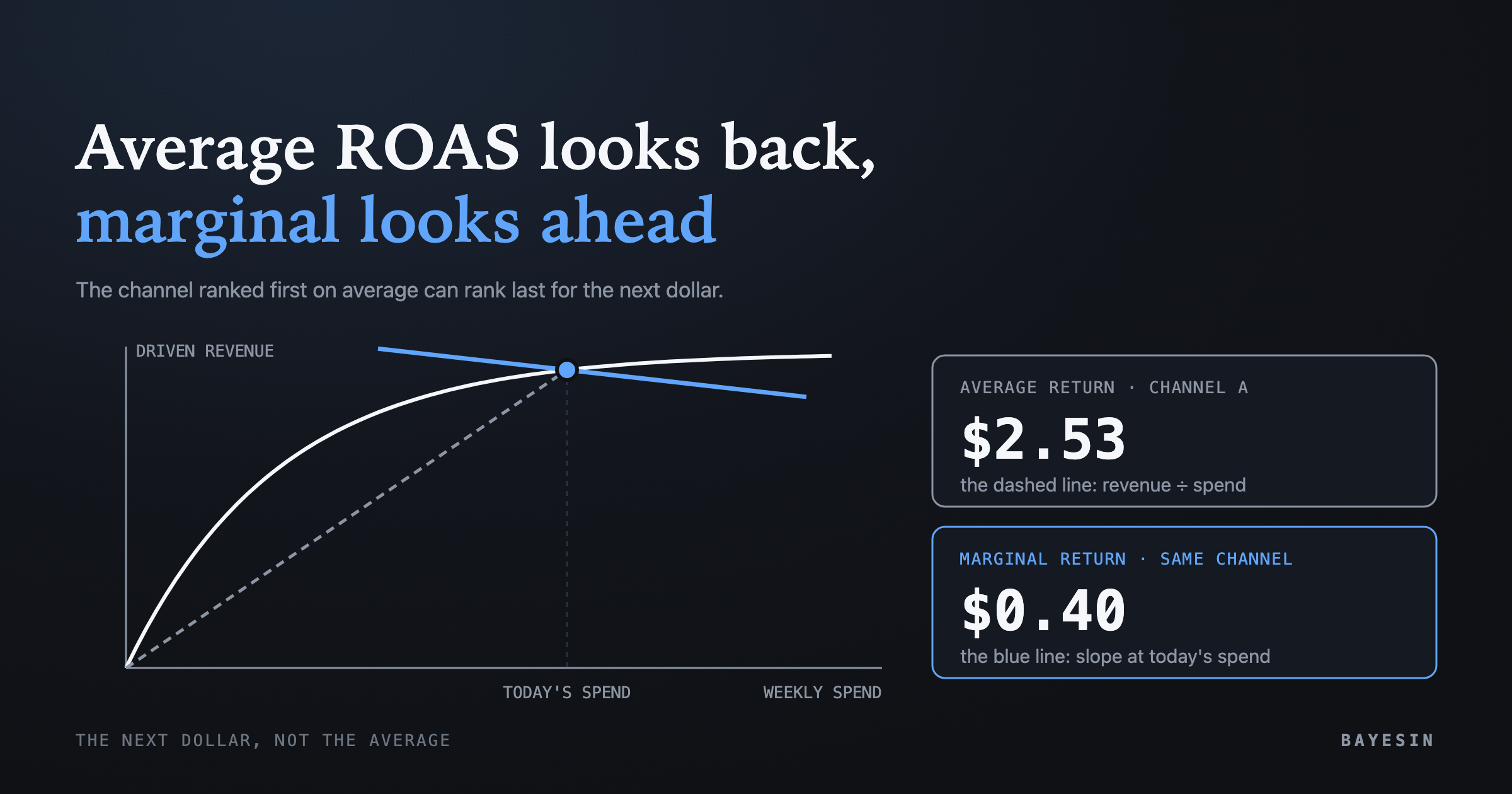
Marginal vs average ROAS: what ROAS by channel leaves out
Marginal vs average ROAS: a channel at $2.53 average return can have a $0.40 marginal return. See what ROAS by channel leaves out and what to add beside it.
Sep 27, 2026
MMM fundamentals
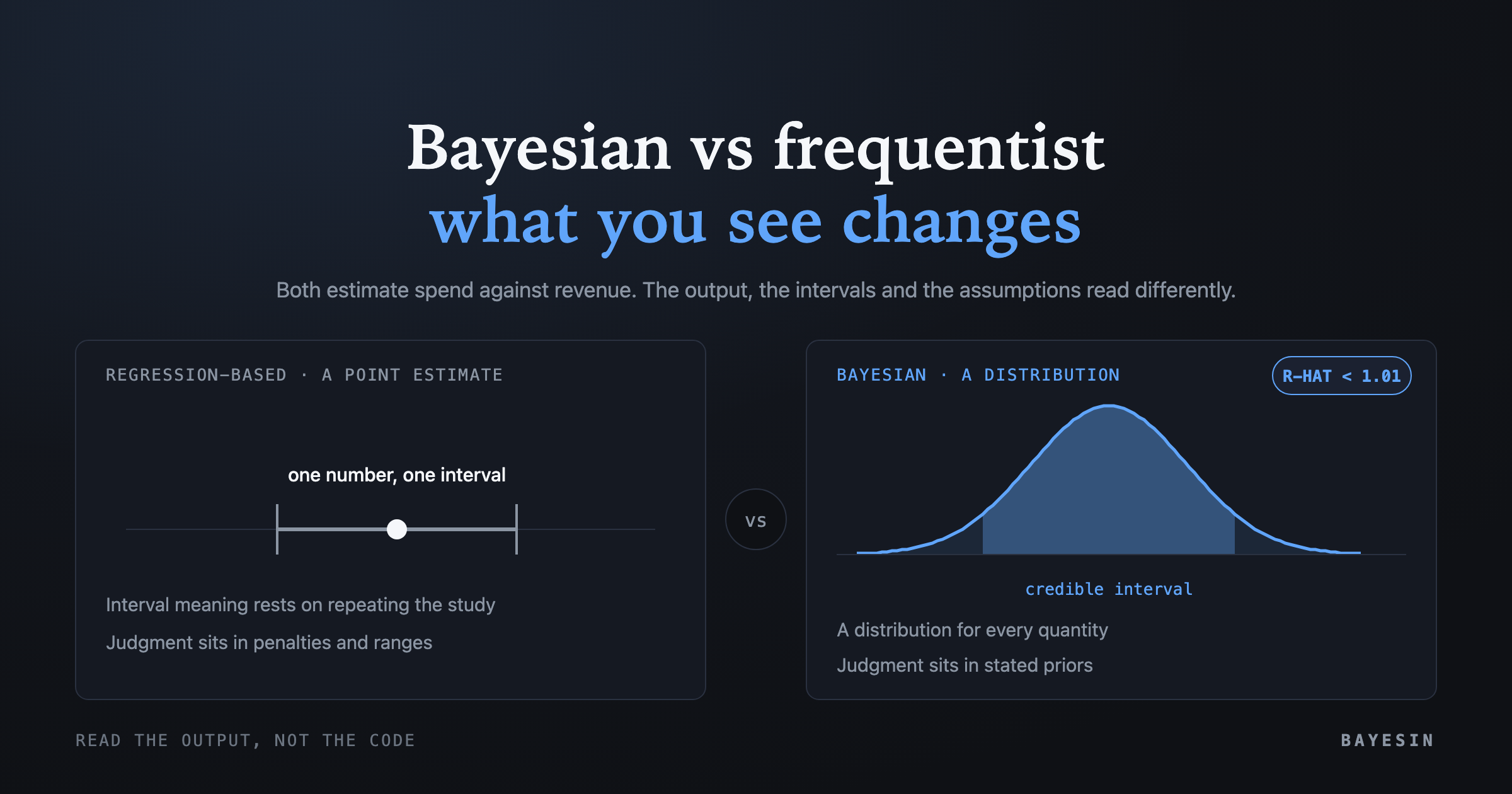
Bayesian vs frequentist MMM: what changes on the page
Bayesian vs frequentist MMM compared by what you see on the page: how intervals read, where assumptions sit, and why a Bayesian fit needs an R-hat below 1.01.
Sep 27, 2026
MMM fundamentals
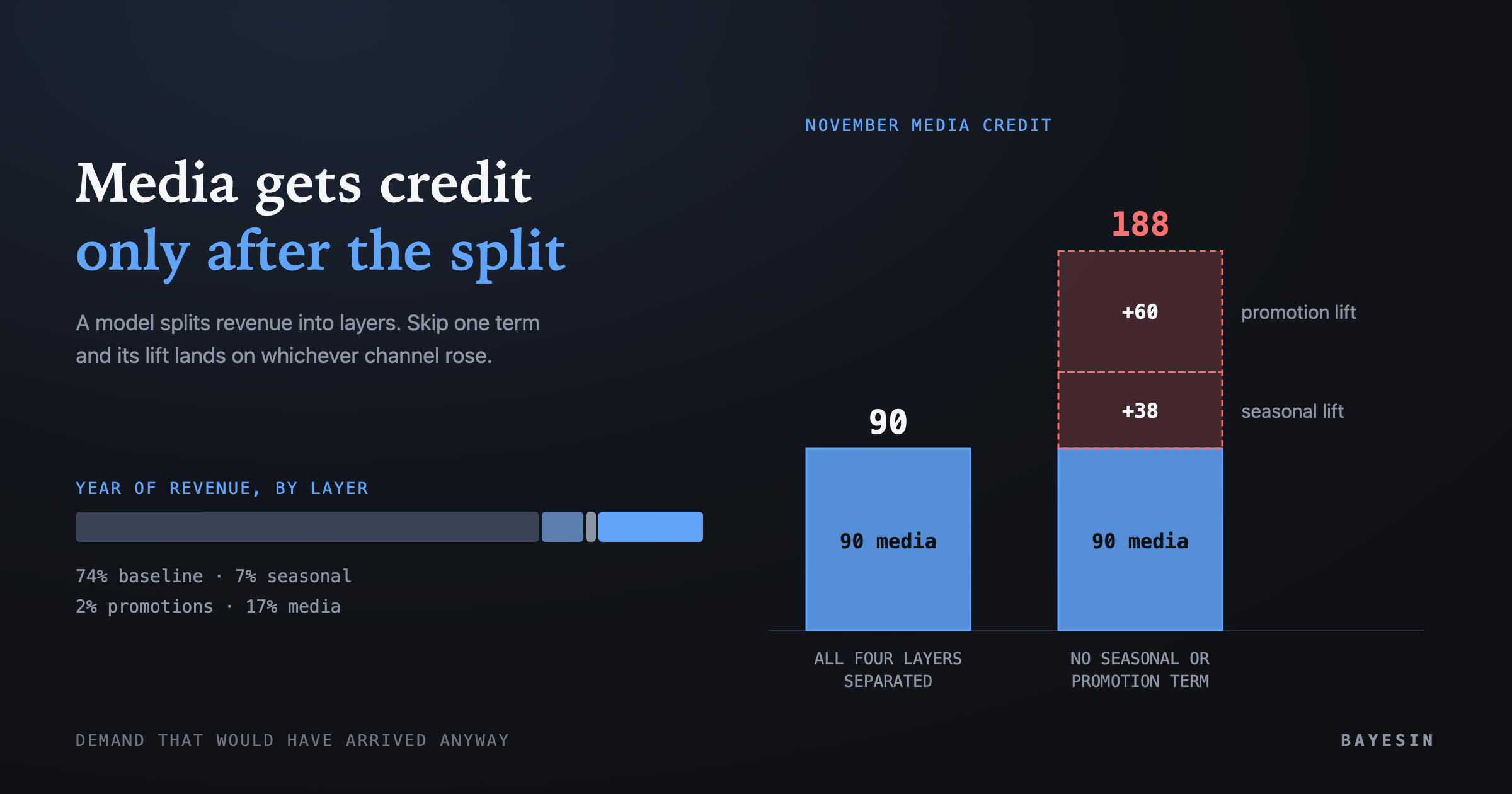
MMM baseline, seasonality and promotions explained
MMM baseline and seasonality explained: how a model splits revenue into four layers, and how skipping one term lifts November media credit from 90 to 188.
Sep 25, 2026
MMM fundamentals
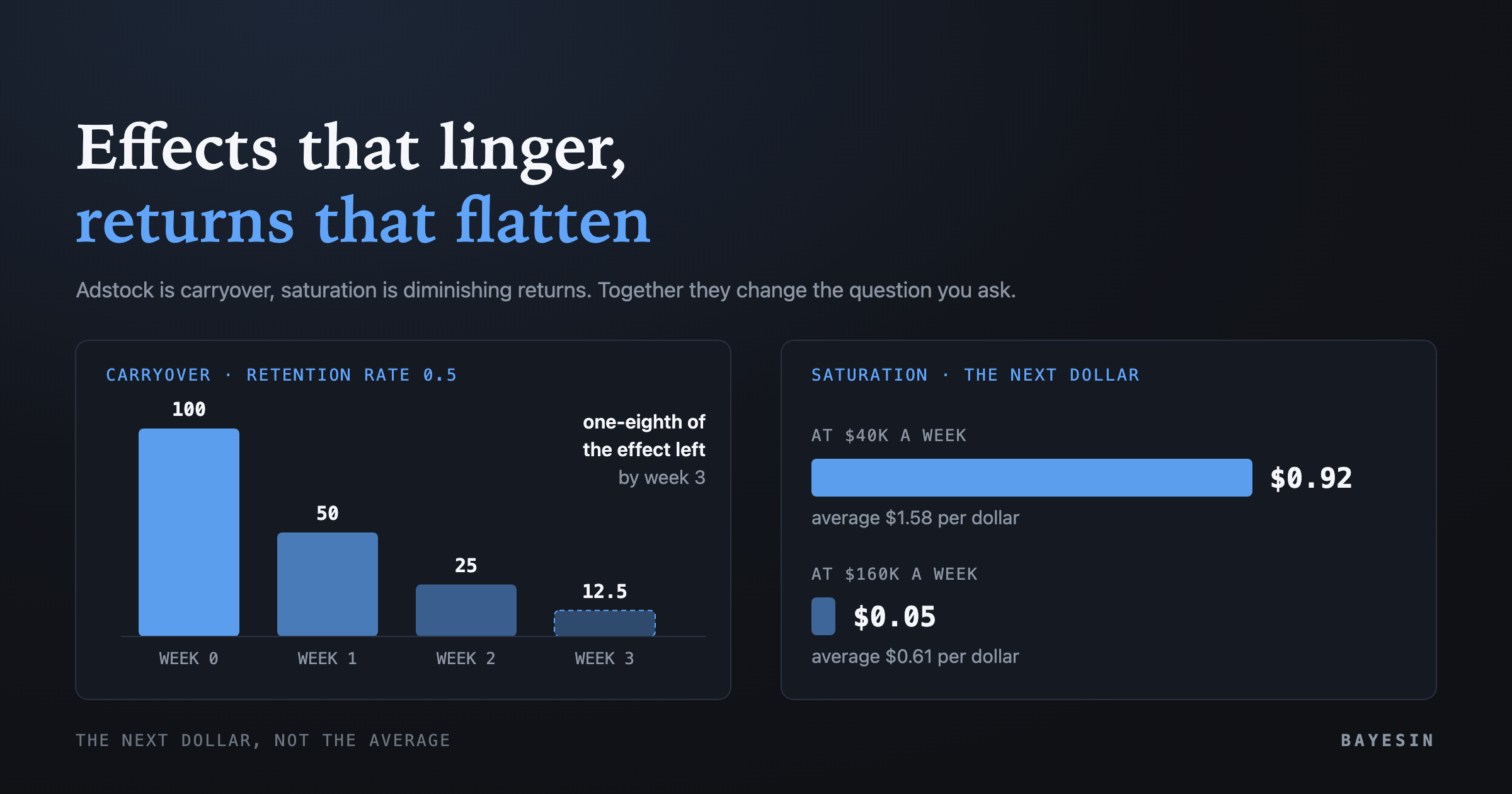
Adstock and saturation explained in plain terms
Adstock and saturation explained in plain terms: a 0.5 retention rate leaves one-eighth of an ad's effect by week 3, and the next dollar can return $0.05.
Sep 24, 2026
Attribution vs MMM
Attribution model bias: why a channel's credit changes
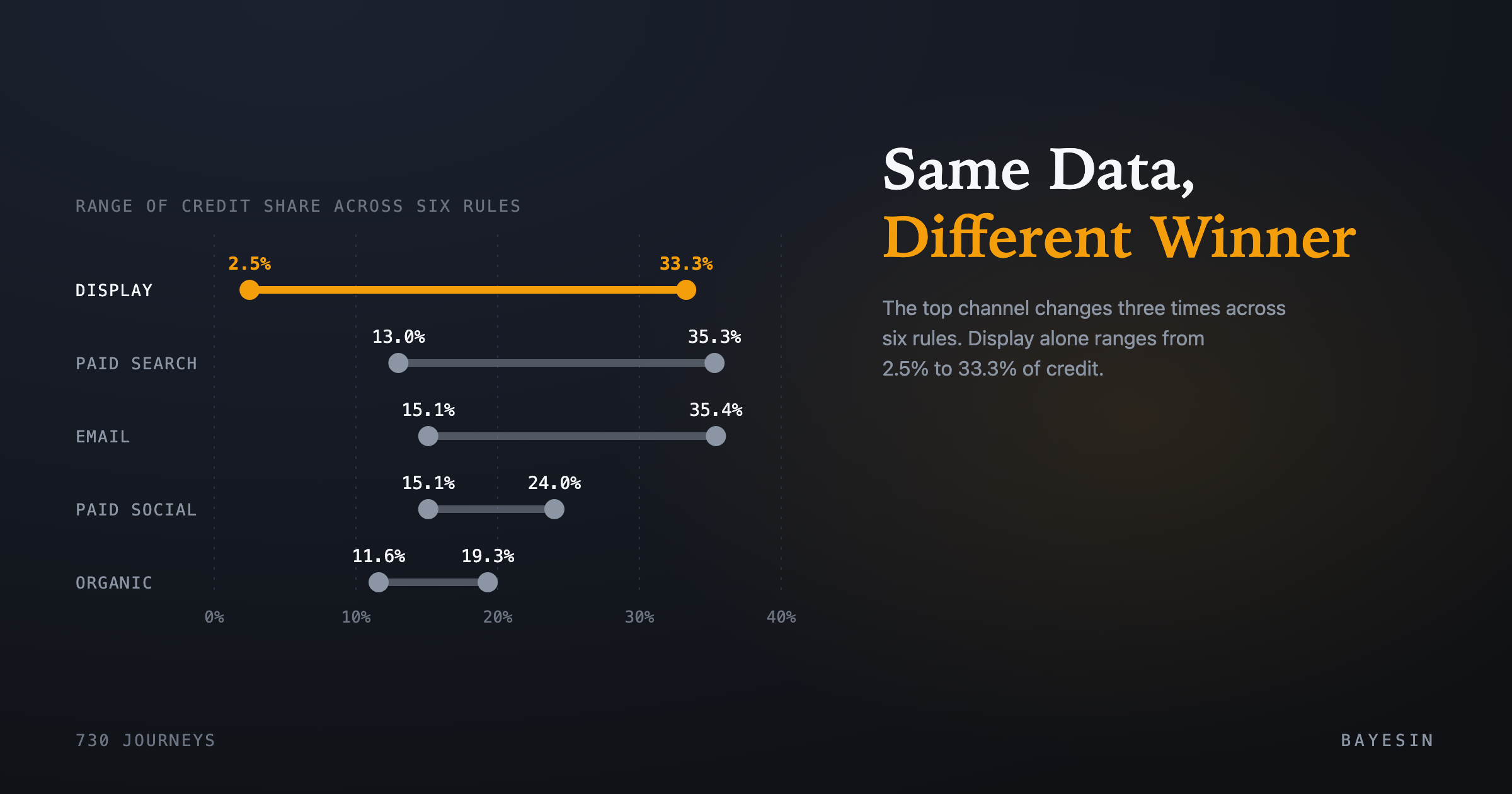
Attribution model bias moved display credit from 2.5% to 33.3% across six rules on 730 synthetic journeys. Measure the spread for your channels in five steps.
Sep 23, 2026
Attribution vs MMM
W-shaped attribution model vs U-shaped, worked by hand
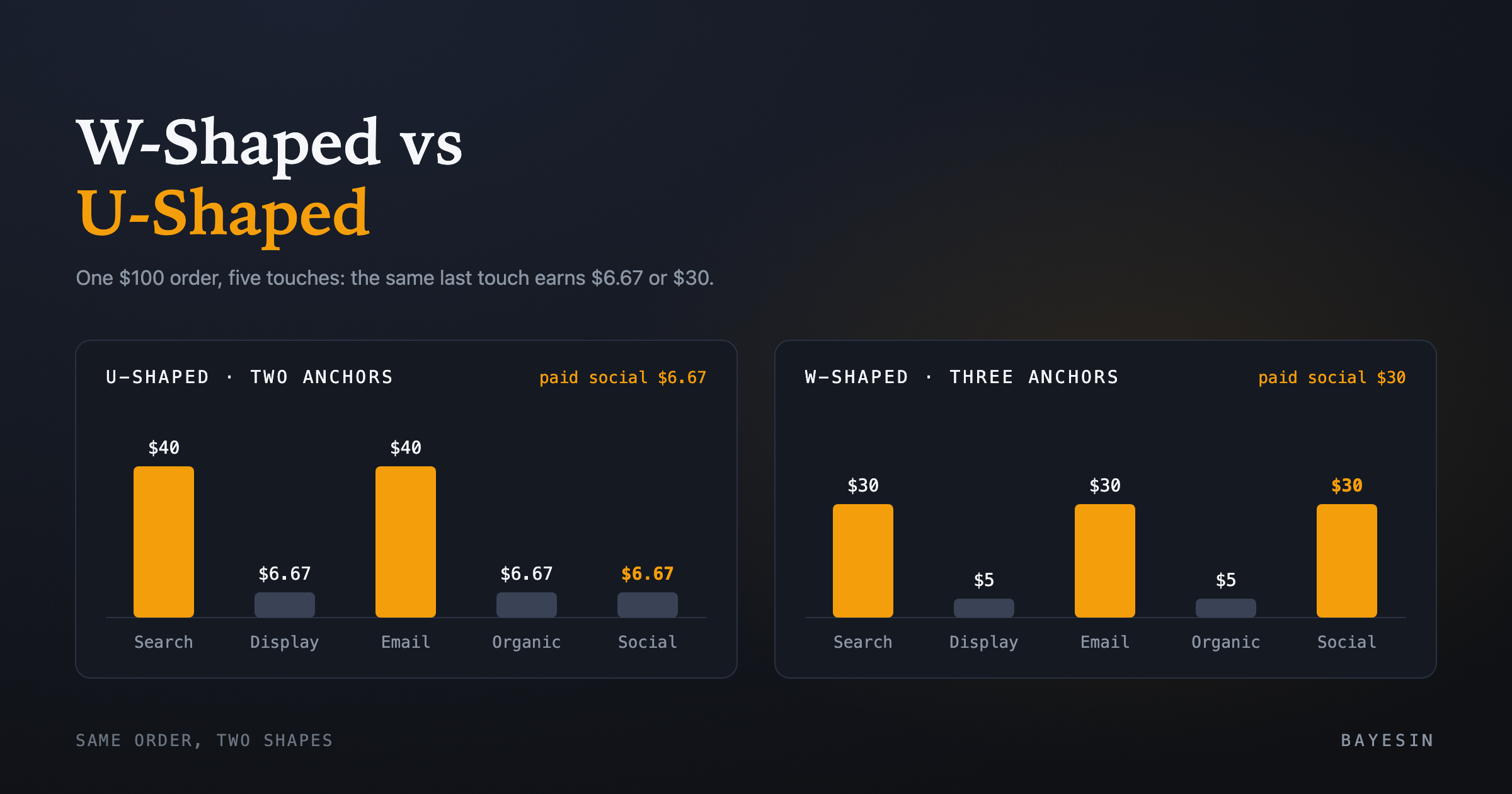
The W-shaped attribution model gave paid social $30 where U-shaped gave $6.67 on one $100 order. Work both by hand and handle the milestone edge cases.
Sep 22, 2026

Attribution vs MMM
Attribution models compared: six rules, one journey
Attribution models compared on one $100 order: paid search earns anywhere from $0 to $100 depending on the rule. See all six credit splits in one table.
Sep 21, 2026
Get new posts by email.
New posts only. See privacy for what we keep.