Attribution vs MMM
W-shaped attribution model vs U-shaped, worked by hand
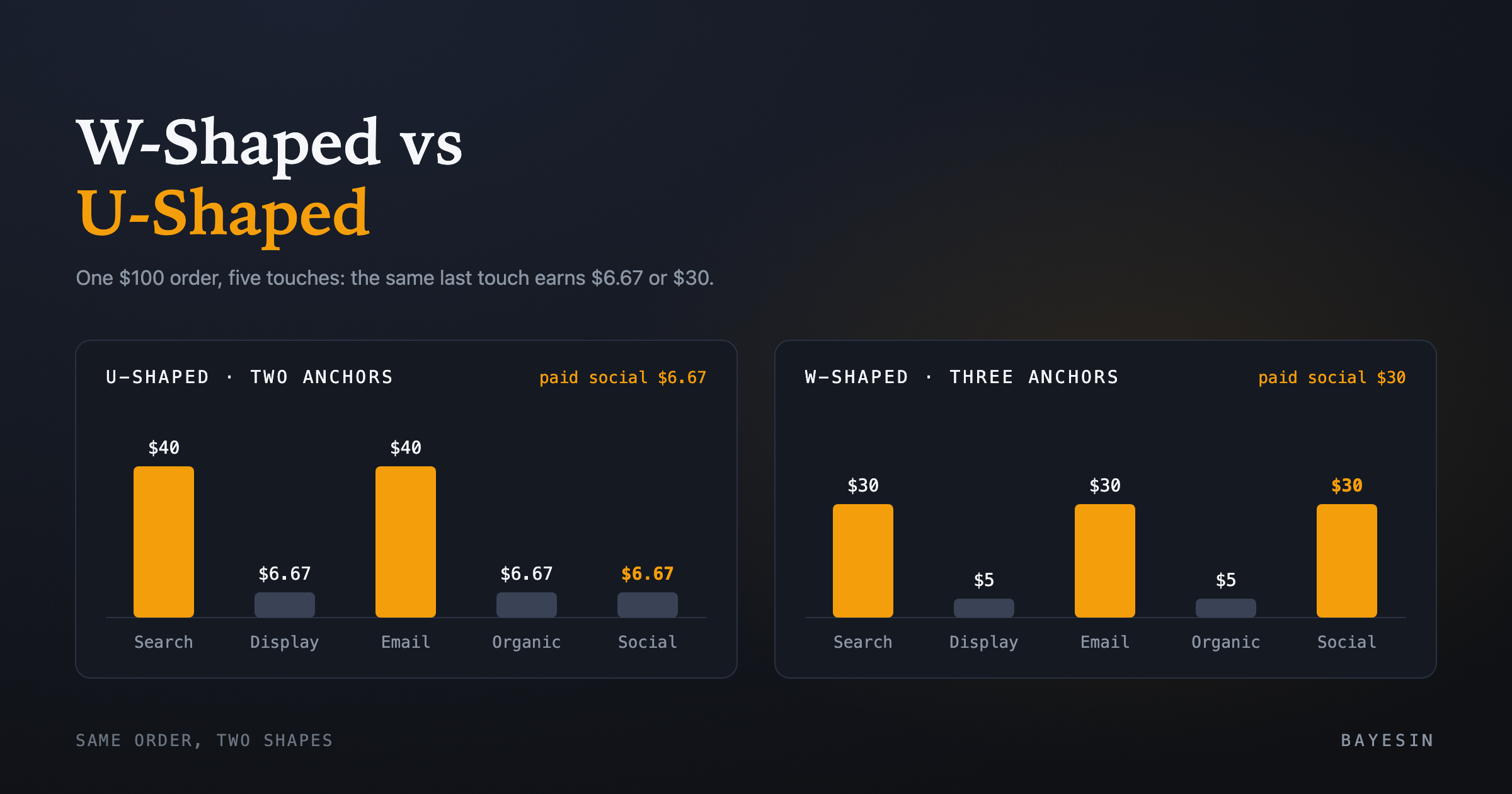
The W-shaped attribution model gave paid social $30 where U-shaped gave $6.67 on one $100 order. Work both by hand and handle the milestone edge cases.
Brandon Cade · Sep 22, 2026 · 7 min read
Key Takeaways
- U-shaped and W-shaped models give fixed shares to anchor touches and split the remainder across the middle.
- They need a milestone touch, such as a lead signup. A journey without one cannot be scored, and that count should be reported.
- Vendors differ. Adobe's U-shaped model anchors on first and last touch; HubSpot's anchors on first touch and lead conversion.
- Edge cases decide the answer: a milestone that is also the first touch, no middle touches, and single-touch journeys all need a written rule.
First touch and last touch ignore the middle of a journey, and linear treats every middle touch like every other one. The W-shaped attribution model and its two-anchor relative, the U-shaped model, occupy the ground between those poles. Each names a few touches as important and shares the rest. This tutorial builds both by hand so that you can verify any tool's output.
What do U-shaped and W-shaped attribution do?
Both models assign fixed percentages to anchor touches, which are the touches that receive a predetermined share of credit. They divide the remainder across the middle. U-shaped uses two anchors, the first touch and a milestone, while W-shaped adds the last touch as a third anchor. Credit therefore peaks at named positions and traces a U or a W.
Those shapes explain why the models exist: first touch and last touch treat the middle as empty, while linear dilutes the important moments. Anchors let you state which stages of a journey deserve their own credit, and they make that judgment explicit. Read Attribution models compared: six rules, one journey first if you want all six rules applied to a single order.
The milestone touch
A milestone touch is the touch at which a customer reaches a stage you care about, such as creating a lead. It distinguishes these models from plain first and last rules. You must choose it before you calculate, because the entire result depends on that decision. A journey without a milestone has no U or W shape.
Pick a milestone that appears once per journey and that your team already tracks. Lead creation is a common choice, and a form submission or a demonstration request can also work. If the same event can occur several times, decide in advance whether the first or the last occurrence receives the credit, and document that rule.
How does the W-shaped attribution model calculate credit next to U-shaped?
U-shaped credit allocates 40% to the first touch, 40% to the milestone and 20% equally across every other touch. W-shaped credit allocates 30% to the first touch, the milestone and the last touch, then divides the final 10% equally across the rest. A $100 order makes the arithmetic straightforward to verify.
This journey has five touches: paid search, display, an email lead signup, an organic visit and a paid social advertisement, followed by the purchase. The six-models post used a four-touch journey without display, so the numbers differ by design. All figures are synthetic, not real customer data.
Paid search is the first touch and the email lead signup is the milestone, so under U-shaped each earns 40% of the order. The other three touches share the remaining 20% equally. Paid social is the last touch, yet it is not an anchor in this model, so it joins the middle pool.
Under W-shaped, the last touch becomes an anchor, so paid search, the email and paid social each earn 30%. Display and organic share the final 10% equally, and the three peaks explain the "W" in the name.
What does the same journey look like under each model?
The table converts those percentages into dollars for the synthetic order, and the figure draws the same values as bars.
- Paid search — Role: First touch; U-shaped: $40.00; W-shaped: $30.00
- Display — Role: Middle; U-shaped: $6.67; W-shaped: $5.00
- Email lead signup — Role: Milestone; U-shaped: $40.00; W-shaped: $30.00
- Organic — Role: Middle; U-shaped: $6.67; W-shaped: $5.00
- Paid social — Role: Last touch; U-shaped: $6.67; W-shaped: $30.00
Credit on one synthetic $100 order. U-shaped totals $100.01 because of rounding. Illustrative data, not customer data.
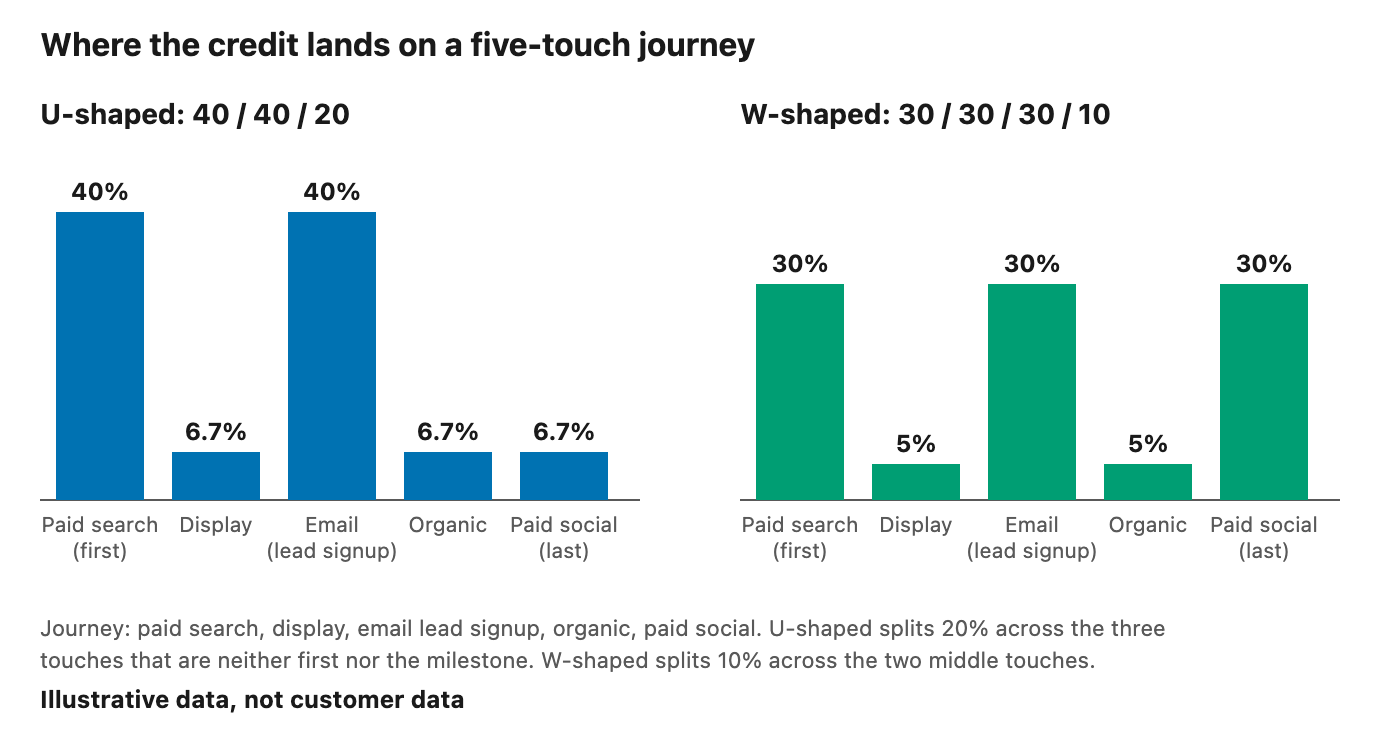
U-shaped and W-shaped weights on one synthetic journey. Illustrative data, not customer data.
Compare the two columns. Paid social rises from $6.67 to $30 between the models, while display and organic fall slightly. A single shift explains the difference on this journey, because the last touch moves from the middle pool to an anchor.
Edge cases that change the answer
Edge cases are where tools disagree, because the percentages alone do not specify what happens when anchors coincide or the middle is empty. The four rules below are conventions that you can adopt and document, not laws, and your tool may follow different ones.
The journey has no milestone touch
A U-shaped or W-shaped model cannot score such a journey, so count these journeys and report their number and value beside the results. Do not quietly credit them with a different rule, because that hides a change in what the number means. Leave them out of the comparison and say so explicitly.
The milestone is also the first touch
The two anchors land on the same touch, and one simple convention gives that touch both shares. It then earns 80% under U-shaped and 60% under W-shaped, plus the last-touch share when it is also the last touch. The total stays at 100%, which keeps the rule easy to explain.
There are no middle touches
Suppose a journey has only display, an email milestone and a paid social advertisement. Under U-shaped, paid social is the only non-anchor touch, so it takes the 20% pool and the split is $40, $40 and $20. Under W-shaped there are three anchors and no middle, so the 10% pool needs a home.
One convention redistributes the pool across the anchors in proportion to their weights, which here gives each anchor $33.33. Another leaves the pool unassigned and reports it, and either approach is defensible if you state it.
The journey has a single touch
That touch takes 100%, because there is nothing to divide and every model degrades to the same answer. Keep single-touch journeys in the totals so that your coverage figure stays honest.
Vendor definitions differ
Names travel between vendors, but weights do not. Adobe's documentation describes U-shaped as 40% to the first interaction, 40% to the last interaction and 20% split among the middle touchpoints. HubSpot's U-shaped model replaces the last interaction with the lead conversion interaction, so two tools that share a name produce different outputs.
Adobe also lists J Curve and Inverse J models that use 60/20/20 splits. Its Custom model lets analysts set weights for the first touch, the last touch and the touches between. HubSpot documents a Full Path model with 22.5% on each of four anchors and 10% shared across the rest.
Position-based rules were once a standard menu item in Google's tools. The six-models post summarizes which models Google Ads and Google Analytics 4 still offer. If you want a position-based view now, compute it yourself from journey data.
When does the middle matter?
The middle matters when a stage in your pipeline deserves its own credit and you can identify it reliably. Lead generation and B2B pipelines fit, because becoming a lead is a real event with a timestamp. If your purchase path has no meaningful stage, U-shaped and W-shaped add complexity for little benefit.
Even then, remember what these models are: they divide observed credit by position, and they do not show that the milestone touch caused the milestone. The pillar page explains why observational credit, including position-based credit, cannot stand in for an experiment.
Use these models to tell a clear story about funnel stages, and use experiments or a media mix model to test cause. Why a channel's credit changes with the model you pick shows how far these choices can move a channel's share.
Frequently asked questions
What is the difference between U-shaped and W-shaped attribution?
U-shaped uses two anchors, the first touch and a milestone, with 40% each and 20% across the rest in the common version. W-shaped adds the last touch as a third anchor, and typical percentages are 30% each for three anchors and 10% across the rest.
Which milestone should I choose?
Choose an event that occurs once per journey, has a reliable timestamp, and marks a stage your team already reviews, such as lead creation. Avoid events that fire on almost every visit, since they turn the milestone into an arbitrary middle touch and blur the model.
Is W-shaped better than U-shaped?
Neither is better in general. W-shaped suits journeys where the closing touch matters as much as the opener and the milestone. U-shaped is simpler and needs one fewer decision, so compare both on the same conversions and see how much your conclusions move.
Can I use these models without a defined milestone?
No. Without a milestone the anchor has nowhere to land, so use first touch, last touch, linear or time decay instead. If some journeys have a milestone and others do not, score the first group and report how many journeys you left out.
Sources
See it on your own rows.
Bayesin is pre-launch. Join the waitlist and we will reach out as access opens.
Get new posts by email.
New posts only. See privacy for what we keep.