MMM fundamentals
Priors in a Bayesian marketing mix model, explained
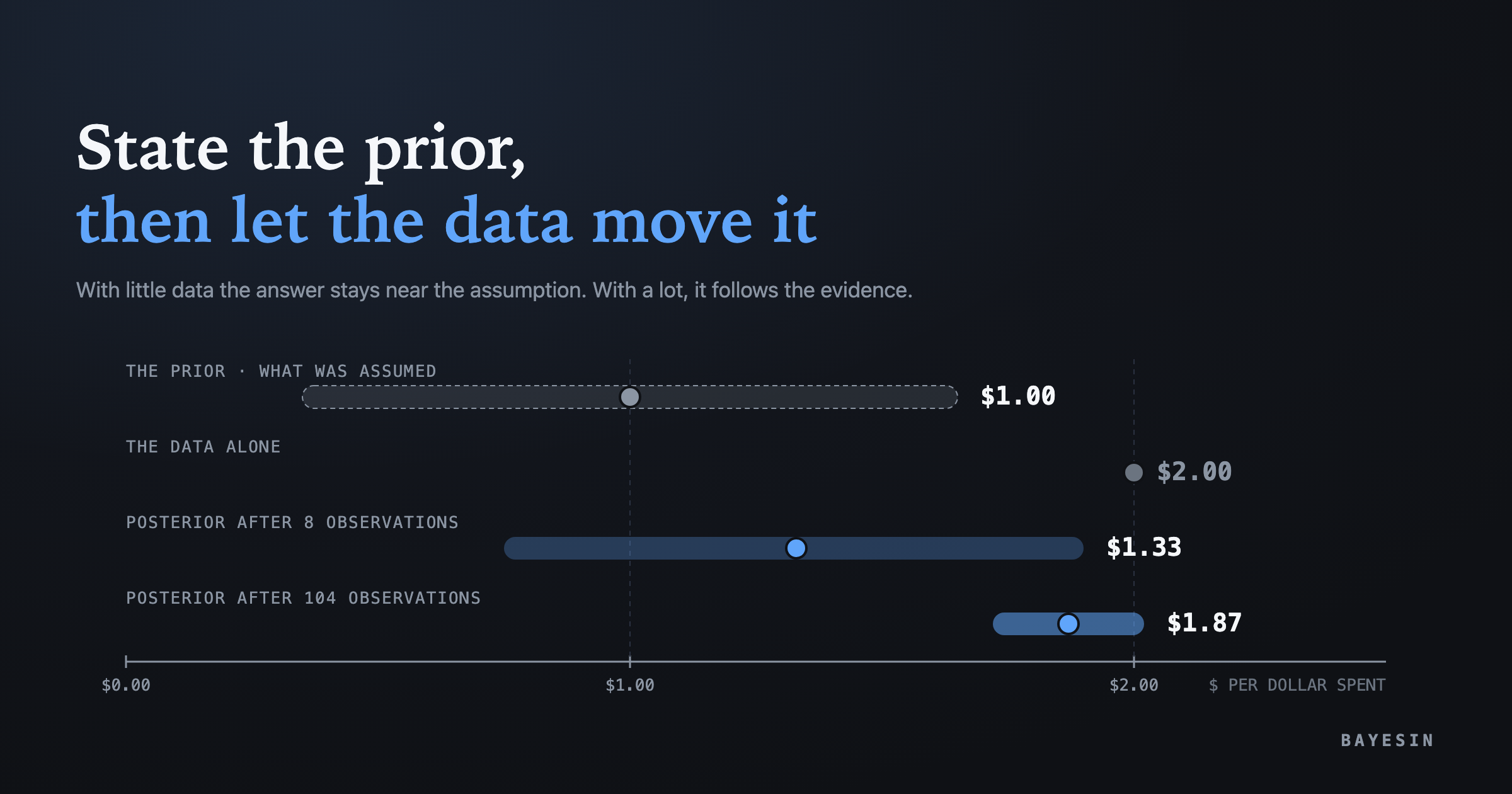
Priors in a Bayesian marketing mix model, explained: a $1.00 prior moves to $1.33 with 8 observations and $1.87 with 104, plus how to read and test a prior.
Brandon Cade · Sep 28, 2026 · 8 min read
Key Takeaways
- A prior is a stated assumption about a parameter before the model sees your rows. Every Bayesian MMM has priors, whether or not the report shows them.
- With little data, the posterior stays close to the prior. With a lot of data, it moves toward the data.
- Good priors come from experiments, past results and physical limits, such as revenue that cannot be negative.
- A sound MMM lists its priors and lets you test them: refit with a wider prior and see whether the ranking of channels survives.
Every media mix model makes assumptions. A Bayesian model has the advantage of writing them down as priors, in a form you can read and question. The trouble starts only when the report leaves them out. This guide explains priors in a Bayesian marketing mix model. It covers what a prior is, why it matters more for an MMM than for many models, and how you can check one.
Priors in a Bayesian marketing mix model: what a prior is
A prior is a probability distribution that describes what is believed about a parameter before looking at your data. For a channel, it might say that the return on the next dollar is probably positive and probably below some ceiling. The model combines that belief with your weekly rows to produce a posterior.
Google's Meridian documentation, as of 2026, defines priors as beliefs about parameter distributions before analyzing data. It separates informative priors, which express high certainty and need a large amount of data to overcome, from uninformative priors, which assume very little.
It also explains the mechanics. If the data holds little information, the posterior is weighted more toward the prior. If the data holds a lot, the posterior is weighted more toward the data. That one sentence is most of what you need to know.
Priors matter more in an MMM because the data is thin
Weekly data accumulates slowly. Three years of history is only 156 rows, and the model must estimate many parameters from them. Channels can also move together, which makes them hard to separate. When data is thin and correlated, priors do real work, so they deserve the same scrutiny as any other input.
In 2017, Google researchers Yuxue Jin and colleagues studied this directly in "Bayesian Methods for Media Mix Modeling with Carryover and Shape Effects." They report that the model performs well with large datasets, while priors significantly influence results with smaller samples and can cause bias.
Priors cannot remove the obstacles of limited data and correlated channels, which Chan and Perry describe in the source the pillar guide cites. They can, however, keep the model from wandering into implausible territory when the data leaves a question open.
What are the common kinds of prior?
Statisticians describe a spectrum. At one end is the flat prior, which adds no information, and at the other is a specific informative prior built from domain knowledge. Most MMM work sits in the middle, with weakly informative priors that rule out silly values without forcing an answer.
The Stan project's prior choice guidance, in a version edited in April 2025, lists five levels of informativeness. The table gives each level with the example the page uses.
- Flat prior — Stan's example: No distribution stated; What the page says: Not usually recommended
- Super-vague but proper — Stan's example: normal(0, 1e6); What the page says: Not usually recommended
- Weakly informative, very weak — Stan's example: normal(0, 10); What the page says: Labelled "very weak"
- Generic weakly informative — Stan's example: normal(0, 1); What the page says: Labelled "generic"; contributors differ on a default
- Specific informative — Stan's example: normal(0.4, 0.2), "or whatever"; What the page says: Tailored to domain knowledge
Source: Stan Development Team, "Prior Choice Recommendations." The page does not name any level the standard default. Under its generic weakly informative heading, one contributor uses independent normal(0,1) and another prefers student_t(3,0,1).
The guidance adds two lessons that apply well to MMM. A prior should rule out unreasonable values without being so strong that it rules out values that might make sense. And the prior can often only be understood in the context of the likelihood, meaning the model that connects parameters to data.
A prior and two amounts of data: $1.00 moves to $1.33, then to $1.87
This toy calculation uses synthetic numbers, so they are illustrative and not real customer data. Suppose you believe a channel's marginal return, the revenue from the next dollar, is about $1.00, give or take $0.50. That is your prior.
Now suppose the observations, taken alone, point to $2.00, with noise of $2.00 per observation. With 8 observations, the posterior mean moves only to about $1.33, and the posterior is still wide. With 104 observations, it moves to about $1.87 and narrows sharply.
The prior did not change, but the data did. The example uses a simple normal model to make the arithmetic visible, so it does not describe how many weeks any real MMM needs.
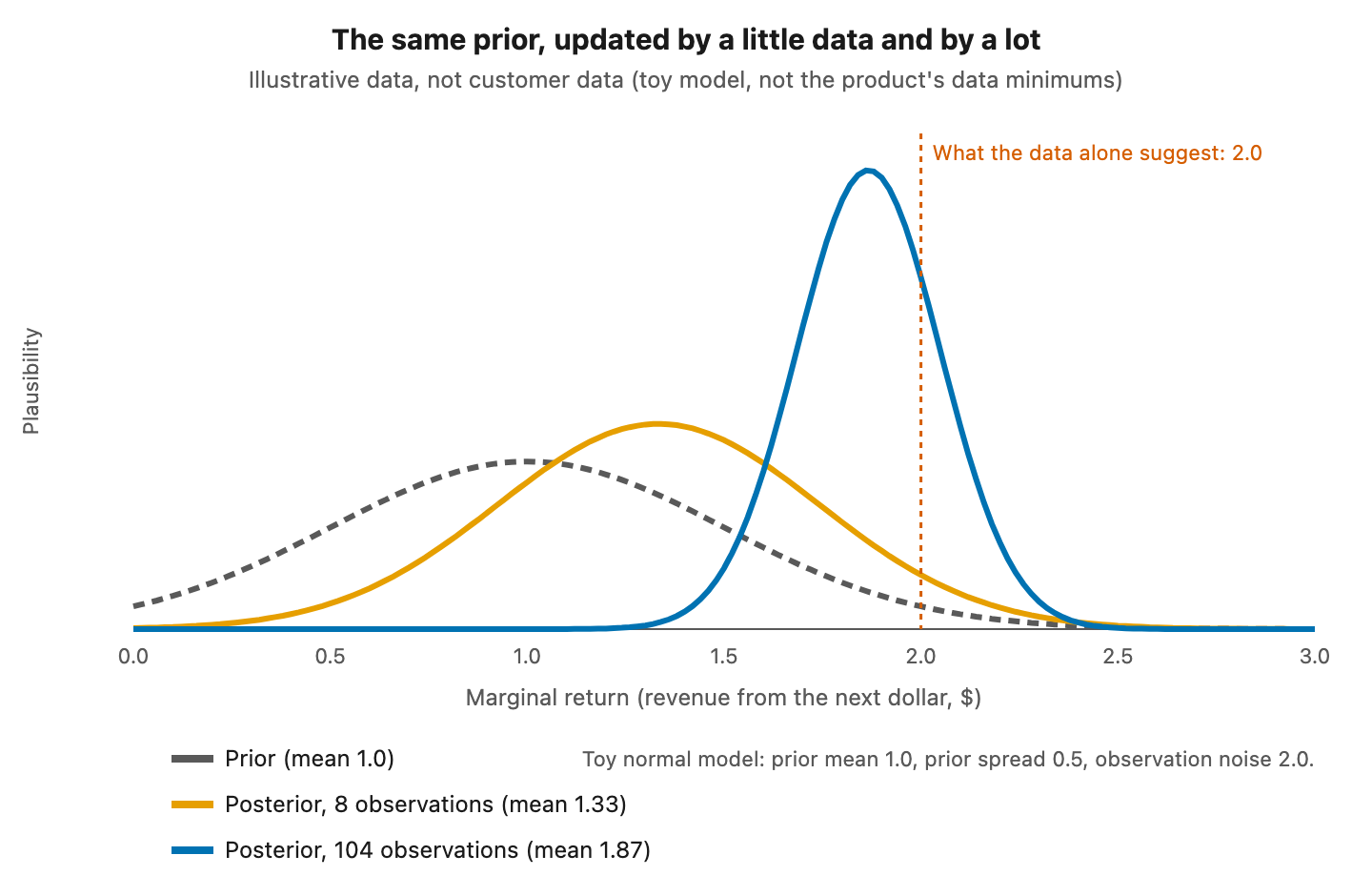
Figure 1. The same prior updated by 8 and by 104 observations.
The takeaway is practical. If a model reports $1.33 from little data, a large share of that number is the assumption. If it reports $1.87 from a lot of data, most of it is evidence. Only a stated prior lets you tell which case you are in.
Good priors come from outside the fit
Good priors come from outside the fit: experiments, earlier studies, accounting limits and plain physical constraints. The best source is an experiment, because it measures incremental effect directly. Priors from experiments turn a lift test from a separate exhibit into an input the model must respect.
In 2024, Google researchers Yingxiang Zhang and colleagues described a way to do this in "Media Mix Model Calibration With Bayesian Priors." Their method lets experiment results inform the prior on return on ad spend. In simulations, they report that it substantially decreases bias and uncertainty in posterior return estimates.
Meridian's documentation gives guidance on which quantity to put the prior on. It suggests return-on-investment priors for paid media, especially when calibrating with experiments, and marginal-return priors when you want budget recommendations shrunk toward the historical allocation. It also notes that setting a prior on one metric implies a prior on the others.
That last point matters. A prior on one quantity is never neutral about the rest, so choose the quantity where your knowledge is strongest.
Some priors need no experiment at all. Revenue with no marketing cannot be negative, so a baseline prior can encode that limit. I discuss what the baseline means in MMM baseline, seasonality and promotions.
A model should state its priors and how much they matter
A model should show, for each parameter, the form of the prior, its scale, and why it was chosen. It should also show how much the answer moves when the prior changes. Stan's guidance puts the first part simply. When using informative priors, be explicit about every choice, and write a sentence about each parameter.
A checklist you can hold any MMM report to:
- Which parameters have priors: carryover, saturation, channel effect, baseline, seasonality, noise?
- What is each prior's shape and scale, in units you can read?
- Where did the informative ones come from: an experiment, a past model, a constraint?
- Is there a sensitivity check that reruns the model under different priors?
- Do the channel rankings survive that check?
Without these answers, a reader cannot separate what the data said from what the modeler assumed. The Bayesian vs frequentist comparison shows that other approaches place judgment elsewhere, so the question applies to every method.
How do you test a prior yourself?
Run a sensitivity check. Refit the model with a tighter prior and a looser one, then compare the intervals and the ranking. If the ranking holds, the data is doing the work. If it flips, the priors are steering the result, and you should say so before you move budget.
PyMC-Marketing's saturation tutorial offers a concrete example. It shows that custom, tighter priors concentrate samples around the mean and produce more stable saturation curves than default priors with broader uncertainty. Priors therefore visibly change the curves that drive marginal return, which I cover in adstock and saturation explained.
A second check is to ask what the prior implies before any data arrives. Simulate from the prior and see whether the revenue it implies is plausible. A prior that implies media drives more than your whole revenue is telling you something about itself.
Frequently asked questions
Are priors just opinions?
They are assumptions, and a good one is grounded in evidence such as an experiment or a physical limit. The difference from a hidden assumption is that a prior is written down and can be tested. Weak priors let the data speak, and strong priors should always cite where the strength came from.
Can I run an MMM without priors?
Not a Bayesian one. Every Bayesian model has priors, even when they are called defaults. Other approaches still make assumptions, such as penalty strengths or parameter bounds. The useful question is not whether assumptions exist, but whether the report states them and shows how much they matter.
What is a weakly informative prior?
It is a prior that rules out implausible values without forcing a particular answer. Stan's guidance gives normal(0, 1) as its generic example for scaled parameters, and its contributors disagree on a default, with one preferring student_t(3,0,1). Whatever the form, the prior should be stated and tested.
How many weeks of data before priors stop mattering?
There is no universal number. It depends on how much your spend varies and how many parameters the model estimates. The reliable signal is your own sensitivity check. When tighter and looser priors give the same ranking with similar intervals, priors are no longer driving the result.
Sources
Every external claim above comes from the pages listed here, each opened on the retrieval date shown.
- Stan Development Team, "Prior Choice Recommendations"
- Google for Developers, "Bayesian Inference in Meridian," Meridian documentation
- Google for Developers, "Choose and configure treatment prior types," Meridian documentation
- Google Research, Jin, Wang, Sun, Chan and Koehler, "Bayesian Methods for Media Mix Modeling with Carryover and Shape Effects"
- Google Research, Chan and Perry, "Challenges and Opportunities in Media Mix Modeling"
- Google Research, Zhang et al., "Media Mix Model Calibration With Bayesian Priors"
- PyMC-Marketing, "Understanding Media Saturation in Marketing Mix Models"
See it on your own rows.
Bayesin is pre-launch. Join the waitlist and we will reach out as access opens.
Get new posts by email.
New posts only. See privacy for what we keep.